How to Brush a Long-Haired Cat and Prevent Mats
Master brushing a long-haired cat with gentle techniques, safe detangling tips, and a simple routine that helps prevent painful mats.
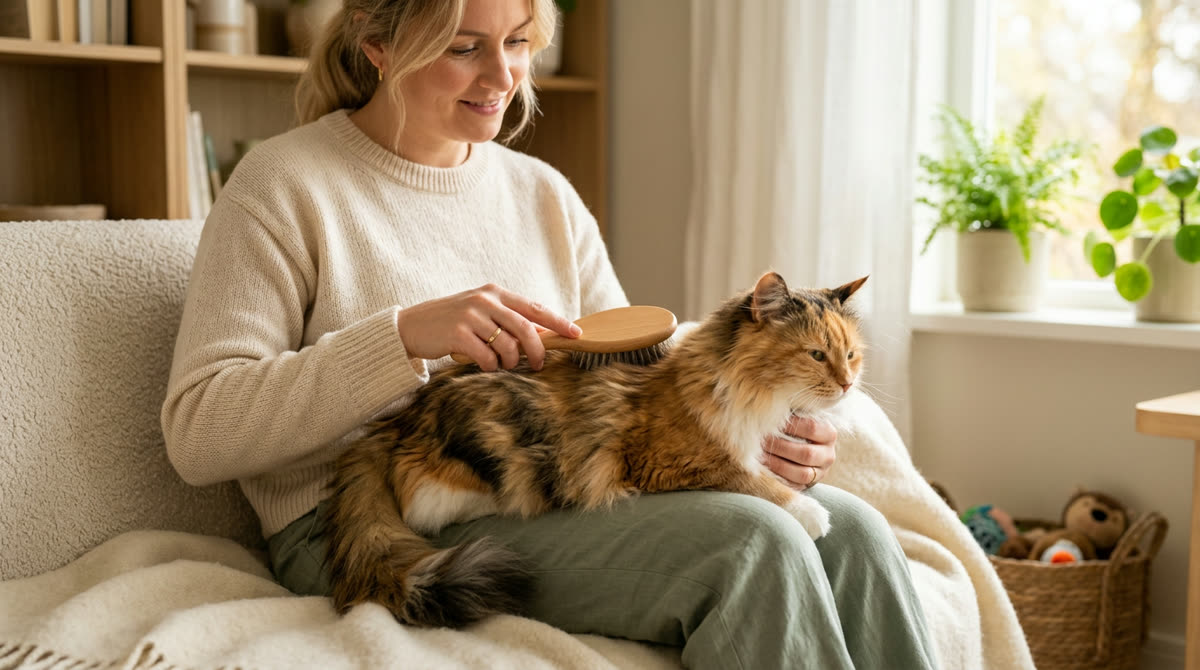
A calm, safety-first approachThis guide provides general education. Contact your veterinarian when symptoms are painful, persistent, or unusual.
- 1
Plan a Routine Around Your Cat’s Coat
Start brushing a long-haired cat with a daily coat check and a manageable grooming schedule, rather than waiting until you can see tangles. For many long-haired cats, a gentle 5–10-minute session each day is a useful starting point, although cats with silky, less dense coats may need thorough brushing less often. Dense undercoats, seasonal shedding, and friction behind the ears or under the legs can make knots develop quickly, so adjust the frequency to what your fingers and comb find. Initially, divide grooming into 1–3-minute sessions if your cat is inexperienced, elderly, or easily frustrated, and work toward longer sessions only while they remain comfortable. Choose a quiet time when your cat is awake but relaxed, such as after play and a short rest, rather than interrupting sleep or an energetic spell. Keep a simple record of which areas you groomed so that short sessions eventually cover the whole coat instead of repeatedly brushing only the easy-to-reach back. If a previously well-kept coat suddenly becomes tangled or greasy, or your cat stops grooming normally, arrange a veterinary check because discomfort or reduced mobility may be contributing.
- Check the coat briefly every day.
- Start with 1–3 minutes for reluctant cats.
- Give dense coats extra attention during shedding.
- Track areas covered across short sessions.
Good to know: Consistency matters more than finishing in one sitting; a calm two-minute session is more useful than a long struggle.
- 2
Inspect the Coat Before You Brush
Run flat fingers gently over your cat’s shoulders, sides, back, and hindquarters, feeling for uneven patches without digging into the coat. Next, check behind the ears, around the collar or harness line, under the front legs, along the belly, and inside the rear legs only as your cat comfortably allows. A loose tangle has strands that separate with light finger pressure, while a compact mat feels like a dense clump or felted patch that does not readily open. Look at the skin where it is visible for redness, sores, moisture, unusual debris, or tenderness, but do not pull a mat upward to inspect underneath it. Stop working on any area that causes flinching, crying, snapping, or a sudden attempt to escape, and contact a veterinarian if pain, irritation, or injured skin is present. Multiple mats, mats lying tightly against the skin, or mats near the genitals or anus need professional assessment rather than forceful home brushing. This inspection prevents a brush from catching an unseen knot and helps you distinguish routine coat maintenance from a problem that needs clipping by a qualified professional.
- Feel behind ears and around collar contact points.
- Check armpits, belly, and rear-leg furnishings.
- Leave tight, dense, or painful mats alone.
- Contact a veterinarian about sore or damaged skin.
Good to know: Never cut out mats with scissors: thin cat skin can be drawn up inside the clump, even when the mat appears to sit away from the body.
- 3
Gather Gentle, Cat-Appropriate Tools
Set out a stainless-steel grooming comb with rounded teeth and both wide and narrow spacing, plus a soft-tipped pin brush or a gentle slicker brush designed for cats. The brush separates coat and collects loose hair, while the comb checks for tangles that a brush can skim over, making the combination more useful than either tool alone. Choose pins long enough to move through the coat without needing to press against the skin, and avoid any brush with bent wires, sharp edges, or missing protective tips. Keep a nonslip mat or folded towel, a few small treats, and a container for collected fur within reach so you do not have to leave your cat unattended on an elevated surface. If you want to use a detangling product, select one explicitly labeled for cats, follow its directions, and apply only where the label permits. Do not substitute human leave-in conditioner, essential oils, or homemade oil mixtures, because your cat will ingest residues while grooming and some ingredients can be harmful. Leave bladed mat splitters, scissors, and aggressive deshedding tools out of this routine, as dense long coats and hidden skin folds make them easy to misuse.
- Rounded-tooth metal comb with two tooth spacings.
- Gentle cat pin brush or soft slicker.
- Nonslip surface and small rewards.
- Optional cat-labeled detangling spray.
Good to know: Lightly pass the brush over your own inner forearm as a rough pressure check; if it scratches or feels harsh, it is not gentle enough for this session.
- 4
Help Your Cat Settle Before Starting
Let your cat sniff the tools on the floor or another stable surface, then reward calm investigation with a tiny treat or a preferred form of attention. Begin with two or three gentle brush strokes over an area your cat usually enjoys being touched, often the shoulders or upper back, and pause before adding more. Keep all four paws supported when your cat is standing, or let them rest on their side voluntarily instead of rolling them over or pinning them down. Pair a few strokes with a reward during the first sessions, keeping treats within your cat’s usual daily allowance rather than offering unlimited snacks. Watch for tail lashing, flattened ears, rippling back skin, head-turning toward the brush, or a stiff posture, since these can signal that your cat needs a break. If those signs appear, remove the brush, give your cat space, and restart later with fewer strokes or a softer tool rather than restraining them more firmly. Building this predictable start-and-stop routine makes daily grooming easier because your cat learns that staying relaxed does not mean losing control of the interaction.
Good to know: Do not scruff your cat or punish swatting and growling; these are warnings to stop, not behaviors to push through.
- 5
Loosen Small Tangles Without Pulling
Before brushing a section, address only small, loose tangles that sit away from the skin and separate readily under your fingertips. Support the hair between the tangle and the skin with your fingers, taking care not to pinch the skin or pull the whole clump upward. Use the other hand to tease apart the outermost strands, working from the free ends of the hair toward the body rather than driving a comb through the knot from its base. Once the strands open, pass the wide-toothed portion of the comb through the ends first and gradually work closer to the skin with light, short movements. If a cat-labeled detangler is appropriate, use the smallest amount directed on its label and allow any specified settling time before trying again. Stop if the tangle does not loosen after a few gentle attempts, if you cannot isolate it from the skin, or if your cat shows discomfort, and ask a cat-experienced groomer or veterinarian to assess it. Repeated pulling can irritate skin and turn future grooming into a battle, whereas recognizing the limit of safe home detangling protects both the coat and your cat’s trust.
Good to know: Do not bathe a matted cat before getting advice; wetting and drying can tighten tangles and make compact mats harder to remove.
- 6
Brush the Coat in Small Sections
Begin at the shoulders and work methodically along one side, then the back and the other side, following the direction in which the hair naturally lies. With your free hand, lift a small layer of coat to expose the section underneath, usually a strip about 1–2 inches wide depending on your cat’s size and coat density. This section-by-section technique, often called line brushing, helps you reach loose undercoat instead of smoothing only the top layer while tangles remain hidden below. Brush the exposed hair using short, gentle strokes toward the ends, keeping the tool from scraping the skin and loosening any resistance rather than pulling through it. Lower the next layer and repeat, removing collected fur from the brush as needed so clogged pins do not drag or become ineffective. Move on once the hair separates easily, because repeatedly brushing the same patch can cause irritation even with a soft tool. Pause after a few minutes to assess your cat’s comfort, and leave the remaining sections for another session if you cannot finish without tension or restraint.
- Work in roughly 1–2-inch sections.
- Follow the natural direction of hair growth.
- Expose lower layers instead of brushing only the surface.
- Clean loose fur from the brush frequently.
Good to know: A large pile of removed fur is not the goal; comfortable skin and a coat that separates easily are better measures of success.
- 7
Groom High-Friction and Sensitive Areas Carefully
After the main body, use the wide-toothed comb and your fingers for shorter, more controlled work behind the ears, around the chest ruff, and along the rear-leg furnishings. These areas need regular attention because movement and rubbing encourage loose hairs to catch together before a mat becomes obvious. For the armpits and belly, wait for your cat to stand comfortably or lie on their side voluntarily, and do not stretch a leg outward to gain access. Keep comb teeth clear of nipples, skin folds, and the genital area, supporting loose skin gently with a flat hand rather than dragging a tool across it. Comb the tail in small sections following hair growth, avoid gripping it tightly, and accept that it may need less frequent work than the mat-prone body areas. If urine or feces repeatedly soils the rear coat, ask a veterinarian about the cause and whether a professionally performed sanitary trim would help. Do not attempt a close scissor trim around the anus or belly, and stop immediately if you find painful knots, wet irritated skin, or contamination trapped tightly against the body.
- Use controlled movements behind ears and under the ruff.
- Let your cat choose a comfortable belly-access position.
- Avoid nipples, folds, and genital tissue.
- Get professional help for persistent rear-end soiling.
- 8
Comb-Check the Coat and Troubleshoot Snags
Finish each groomed section with a light pass of the wide-toothed comb through the full depth of the coat, bringing the teeth close to the skin without pressing into it. If it glides comfortably, try the more narrowly spaced teeth where appropriate, but do not force them through an extremely dense coat simply to achieve a particular finish. A snag means you should stop, lift the surrounding hair, and inspect the area rather than increasing pressure or making repeated passes over the same knot. If the brush seems comfortable but the comb keeps catching, your sections may be too thick or the lower coat may still contain loose hairs that need gentler separation. If your cat objects even when the coat is tangle-free, shorten the session and reconsider the tool and pressure, arranging a veterinary check for new, persistent, or localized sensitivity. Contact a veterinarian promptly for bleeding, sores, a foul smell, discharge, or marked pain, and seek professional grooming help for mats that cannot be opened comfortably by hand. Do not give sedatives, human pain relievers, or other medication to complete grooming; if medication or sedation might be needed, a veterinarian must assess your cat and direct that care.
Good to know: If brushing breaks the skin or the area looks inflamed, stop grooming there instead of applying an unapproved cream or trying to finish the coat.
- 9
Reward Your Cat and Maintain the Results
End while your cat is still reasonably comfortable, offer a small reward, and allow them to leave rather than adding one more difficult area at the last moment. Check exposed skin for redness and note any areas you skipped, then schedule those sections for the next short session so they do not become permanent blind spots. Remove hair from grooming tools after every use, clean them according to the manufacturer’s instructions, and let them dry fully before storage. Maintain the daily hands-on coat check, with particular attention to friction points, and temporarily increase short grooming sessions during noticeable shedding rather than brushing harder. Keep bedding clean and dry, wipe away minor coat soiling promptly with an appropriate damp cloth, and avoid frequent bathing unless your veterinarian recommends it for a specific reason. If mats repeatedly return despite careful brushing, consult a cat-experienced groomer about a maintenance schedule and ask your veterinarian to assess any change in mobility, grooming behavior, or skin comfort. Preventing mats in a long-haired cat is an ongoing partnership: regular gentle brushing handles everyday coat care, while early professional help keeps stubborn tangles from becoming painful problems.
- Reward cooperation and let your cat walk away.
- Record skipped sections for the next session.
- Clean and dry tools between uses.
- Reassess recurring mats with a qualified professional.
Good to know: Senior cats and cats that struggle to reach their back or hindquarters may need more help, but a sudden increase in matting deserves a veterinary check rather than simply more brushing.

Ask about this guide
Leave a comment or a question about your own pet and the Pawlito assistant replies right away with practical next steps.