How to Help an Overweight Cat Lose Weight Safely
Make cat weight loss safer with vet-guided portions, satisfying meals, gentle play, and a tracking plan that protects your cat’s health.
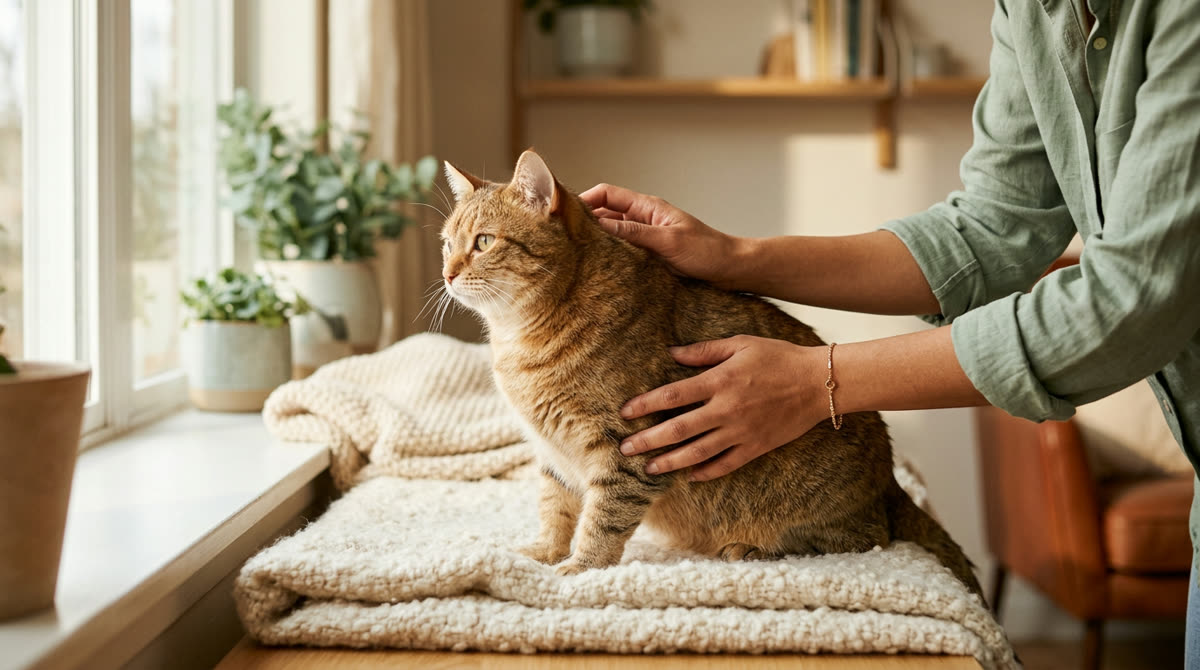
A calm, safety-first approachThis guide provides general education. Contact your veterinarian when symptoms are painful, persistent, or unusual.
- 1
Start with a veterinary weight assessment
Before reducing portions, schedule a veterinary appointment to establish whether your cat is overweight, assess muscle condition, and discuss any health concerns that could affect a weight-loss plan. Bring the names of all foods and treats, photos of their calorie labels, and a 3- to 7-day record of what your cat actually eats, including food borrowed from other pets. Your veterinarian can assess body condition, often on a 9-point scale where 5 is generally ideal, because the number on the scale alone cannot distinguish a large-framed cat from one carrying excess fat. At a healthy body condition, ribs are usually easy to feel beneath a thin fat covering, and a waist is visible from above, although thick fur can hide these features. Do not judge weight by the hanging belly pouch alone; a normal primordial pouch can remain visible even in a lean cat. Ask whether an examination, bloodwork, or other testing is appropriate, particularly if your cat is older, has recently gained weight, drinks more, or seems reluctant to move. This starting assessment makes cat weight loss safer by establishing an appropriate target rather than relying on breed averages or an arbitrary goal.
- Record current weight and veterinary body condition score.
- Bring food labels and a recent feeding log.
- Mention changes in appetite, thirst, grooming, or mobility.
- Ask for an initial target weight and a recheck date.
Good to know: Pregnant or nursing cats, growing kittens, and cats with existing medical conditions need individualized nutritional advice rather than a standard adult weight-loss plan.
- 2
Set a gradual target and daily calorie budget
Ask your veterinarian to provide a daily calorie allowance that accounts for your cat’s estimated ideal weight, current intake, age, activity, and health rather than simply feeding for the cat’s current weight. A commonly used feline weight-loss range is about 0.5% to 2% of starting body weight per week, but your veterinarian may choose the slower end or another individualized target. For example, a 15-pound cat losing 0.5% to 1% weekly would lose approximately 1.2 to 2.4 ounces, or 34 to 68 grams, per week. Expect the process to take months: a cat needing to lose 3 pounds might require roughly 5 to 10 months at that pace, sometimes longer as the plan is adjusted. Write the calorie allowance somewhere everyone who feeds the cat can see, and make clear that treats, toppers, and food used in toys all count toward it. Avoid suddenly halving meals, fasting your cat, or treating the upper end of the weight-loss range as a goal to beat, because severe restriction can cause dangerous nutritional and metabolic problems. Agree on a first progress review, often within 2 to 4 weeks, so the plan can be corrected before an unsuitable calorie level becomes a long-term routine.
- Get a veterinarian-set daily calorie target.
- Record the agreed weekly weight-loss range.
- Include treats and toppers in the budget.
- Plan for months, not a rapid transformation.
Good to know: Rapid weight loss or not eating can put cats, especially overweight cats, at risk of potentially fatal hepatic lipidosis, or fatty liver disease; never use hunger strikes as a weight-management strategy.
- 3
Choose a suitable food and transition slowly
Choose a complete and balanced food appropriate for your cat’s life stage, and ask whether a veterinary therapeutic weight-management diet would be more suitable than simply serving less of the current food. These diets are formulated to provide essential nutrients within a reduced calorie allowance and may use higher protein, adjusted fiber, or lower energy density to support muscle maintenance and fullness. Wet food can provide more water and a larger serving volume for a given calorie allowance, but neither wet nor dry food guarantees weight loss unless total calories are controlled. Compare labels using kilocalories per can, pouch, or gram, since words such as 'indoor,' 'light,' and 'healthy weight' do not tell you exactly how much to feed. Unless your veterinarian advises otherwise, introduce the new food over about 7 to 10 days, starting with roughly 25% new food and gradually progressing through 50%, 75%, and then 100% if your cat accepts it. Those proportions should reflect shares of the daily calorie allowance rather than equal spoonfuls when the foods have different calorie densities. Slow the transition and contact your veterinarian if appetite falls or digestive upset develops, and never withhold a familiar food to force acceptance of a diet your cat refuses.
Good to know: Do not replace a substantial part of a balanced feline diet with plain meat, tuna, vegetables, or supplements; fewer calories must not come at the expense of essential nutrients.
- 4
Measure every portion and account for treats
Use a digital kitchen scale that measures in 1-gram increments to portion dry food, because a slightly rounded scoop can add a meaningful number of calories to a small cat’s daily intake. To convert a label from kilocalories per kilogram to kilocalories per gram, divide by 1,000; a food containing 3,600 kilocalories per kilogram supplies 3.6 kilocalories per gram. If your veterinarian has prescribed 180 calories daily and all of those calories come from that food, the daily portion would be 50 grams, although this example is not a calorie recommendation for your cat. For mixed feeding, subtract wet-food and treat calories first, then calculate the remaining dry-food allowance using the product’s own calorie density. Keep treats to no more than 10% of total daily calories, or less if your veterinarian recommends it, so a 180-calorie allowance would leave at most 18 calories for treats. Each morning, weigh the entire day’s ration into a labeled container and draw meals, training rewards, and puzzle-feeder portions from that supply to prevent accidental double feeding. Measure wet food by weight when practical, follow the manufacturer’s refrigeration instructions for opened containers, and remember that lickable treats, pill-concealing products, and table scraps also contribute calories.
- Use a gram scale rather than estimating by eye.
- Check calories whenever changing foods or flavors.
- Pre-portion one full day of food.
- Count every treat, topper, and edible reward.
- Keep a shared feeding log for the household.
Good to know: Reserve a little of the measured daily food for rewards before serving meals; this makes positive reinforcement possible without adding unplanned calories.
- 5
Build a feeding routine that prevents food stealing
Divide the measured daily ration into 3 to 5 small meals if that suits your cat and household, because predictable access to food can make the change from free feeding easier to tolerate. An automatic feeder can deliver an early-morning or overnight meal without teaching your cat that persistent waking or vocalizing makes a person refill the bowl. Feed cats in separate rooms behind closed doors when their portions or diets differ, and allow roughly 15 to 30 minutes of quiet eating time for cats comfortable with meal feeding. If your cat is a slow grazer, a microchip-activated feeder may preserve access to its allotted food while keeping another pet from stealing it. Replace repeatedly topped-up bowls with measured portions, but make the shift gradually over several days so you can verify that every cat continues eating adequately. Offer fresh water in at least two accessible locations, ideally away from litter boxes and in places where other pets cannot block access. Avoid using competition or very short feeding windows to make your cat eat faster, because stress can interfere with food intake and make a safe weight-loss routine harder to maintain.
- Choose predictable meal times.
- Prevent access to other pets’ bowls.
- Use a timed or microchip feeder when helpful.
- Confirm how much each individual cat eats.
Good to know: For automatic wet-food feeders, use a model designed to keep food appropriately chilled and follow its storage limits; a timer alone does not keep food safe.
- 6
Add gentle activity and food-based enrichment
Start with two or three 3- to 5-minute play sessions each day, adjusting the pace to your cat’s current fitness rather than expecting an overweight cat to chase continuously. Move a wand toy along the floor like prey, pause behind a box, and let your cat stalk and catch it, since achievable hunting sequences are often more engaging than frantic movement. Over 1 to 2 weeks, gradually lengthen enjoyable sessions or add another short session, allowing breaks whenever your cat slows down or disengages. Offer easy food puzzles using part of the measured ration, beginning with kibble in a shallow tray or a loosely filled rolling feeder so frustration does not prevent eating. Encourage comfortable movement with nonslip rugs, low platforms, and ramps to favorite resting spots instead of requiring repeated high jumps that may strain uncomfortable joints. Track activity as a supporting habit rather than a reason to increase portions, because food intake usually has a greater effect on feline weight loss than the calories burned during a short game. Stop exercise and contact your veterinarian if your cat limps, appears painful, or becomes unusually exhausted, and seek urgent veterinary attention for open-mouth breathing, collapse, or breathing difficulty.
- Begin with short, low-impact play sessions.
- Make toys easy to catch and puzzles easy to solve.
- Use daily-ration food in activity feeders.
- Provide stable footing and low climbing options.
Good to know: Put away string, ribbon, and wand toys after supervised play to prevent swallowing injuries, and never force a cat onto a treadmill or into sustained exercise.
- 7
Weigh weekly and adjust using trends
Weigh your cat once a week on the same scale, ideally at the same time of day and before a meal, to reduce variation caused by food, water, and toileting. A pet or baby scale with resolution fine enough to detect changes of a few tens of grams is usually more useful than an ordinary bathroom scale for tracking a cat’s small weekly losses. Place the scale on a firm, level surface, use a nonslip towel if needed, and subtract the towel or carrier weight by zeroing the scale before adding your cat. Record the date, weight, daily calorie allowance, appetite, and any unusual symptoms, then calculate the weekly percentage lost by dividing the weight change by the previous week’s weight and multiplying by 100. Look for the agreed trend over 2 to 4 weeks rather than reacting to one slightly higher or lower reading, and bring the log to veterinary rechecks so body condition and muscle can be assessed alongside weight. If weight has not decreased after 2 to 4 weeks of accurately measured feeding, ask your veterinarian to review the plan instead of repeatedly cutting portions yourself. Contact the clinic sooner if loss exceeds the prescribed range, especially if it approaches or exceeds 2% in a week, because an overly rapid drop or unexpected change needs assessment.
- Use the same scale and similar weighing conditions.
- Log weight and actual food intake weekly.
- Review multiweek trends rather than daily fluctuations.
- Ask for guidance before changing the calorie budget.
Good to know: If home weighing is stressful or unreliable, ask whether your clinic offers brief weight-check visits; a consistent, calm method matters more than collecting frequent numbers.
- 8
Troubleshoot hunger, plateaus, and appetite changes
If your cat begs between meals, first check whether portions match the veterinary plan, then try dividing the same calories into more meals, scheduling play before feeding, or discussing a more filling diet with your veterinarian. For a weight-loss plateau, audit 7 days of actual intake for overlooked sources such as another pet’s bowl, extra family treats, spilled kibble, and calorie differences between flavors. Avoid answering every vocalization with food; a brief brushing session, gentle attention, or a toy may meet a social need without adding calories, provided your cat is otherwise comfortable and eating normally. Do not dismiss newly intense hunger, increased thirst, vomiting, diarrhea, or a sudden behavior change as a normal part of dieting, because these signs warrant veterinary advice. If your cat stops eating or suddenly eats much less, stop further calorie restriction and contact your veterinarian promptly rather than waiting for the next scheduled weigh-in. A cat that has eaten nothing for 24 hours needs urgent veterinary assessment, and you should seek help sooner if there is lethargy, repeated vomiting, weakness, yellowing of the eyes or gums, or any other sign of illness. While arranging advice, offer a familiar, appropriate food and fresh water, but do not force-feed, give human weight-loss products, or try to solve appetite loss with unprescribed medication.
Good to know: A cat eating only tiny tastes may still be receiving far too little nutrition; judge intake against the normal measured ration rather than treating any nibble as reassurance.
- 9
Transition to maintenance and protect progress
Once your cat approaches the agreed target, schedule a veterinary reassessment to confirm that body condition and muscle condition are appropriate rather than continuing until an arbitrary scale number is reached. Ask for a maintenance calorie allowance, which may differ from the weight-loss allowance and should be adjusted according to your cat’s subsequent weight trend. If an increase is needed, your veterinarian may recommend small changes, such as roughly 5% to 10% at a time, rather than an immediate return to the portions that caused weight gain. Continue weekly weigh-ins for the first month of maintenance, then move to monthly checks if weight remains stable and your veterinarian agrees. Keep using weighed portions, separate feeding arrangements, and short daily play sessions, because these routines prevent gradual regain more reliably than occasional crash diets. Contact your veterinarian if weight consistently drifts upward across successive checks or falls unexpectedly, and arrange regular wellness visits to review nutrition as age, activity, and health change. Successful cat weight loss ends with a sustainable routine: comfortable movement, reliable eating, preserved muscle, and a healthy weight your cat can maintain without repeated cycles of restriction.



Ask about this guide
Leave a comment or a question about your own pet and the Pawlito assistant replies right away with practical next steps.