How to Get a Cat to Drink More Water Every Day
Get your cat drinking more water with smart bowl placement, wet-food upgrades, fountain tips, and a safe daily hydration routine.
A calm, safety-first approachThis guide provides general education. Contact your veterinarian when symptoms are painful, persistent, or unusual.
- 1
Check for health concerns before changing the routine
Before encouraging your cat to drink more water, decide whether you are improving an everyday habit or responding to a new change in thirst, appetite, or litter-box use. Cats eating mostly wet food may rarely visit a water bowl because their meals already supply substantial moisture, so infrequent visible drinking does not automatically mean inadequate hydration. Conversely, a sudden increase in drinking or noticeably larger urine clumps deserves a veterinary appointment rather than congratulations for better hydration, especially if it accompanies weight loss or appetite changes. Contact your veterinarian promptly if your cat drinks much less than usual and also seems lethargic, vomits repeatedly, or eats poorly; home checks such as skin tenting cannot reliably establish hydration status. Repeated straining, crying in the litter box, or passing little or no urine requires emergency veterinary care immediately, particularly in male cats. If your cat has a diagnosed medical condition, takes medication, or follows a prescription diet, ask the veterinarian whether changes to food, water additives, or fluid intake are appropriate before proceeding. Never withhold water to encourage drinking later, and never syringe water into an unwilling cat’s mouth because this can cause distress and aspiration.
- Note recent changes in thirst, appetite, and energy.
- Check for changes in urine clump size or frequency.
- Seek emergency care for straining with little or no urine.
- Confirm dietary restrictions before adding foods or flavorings.
Good to know: Do not wait for a home hydration experiment to work if your cat appears unwell; drinking strategies cannot replace veterinary assessment.
- 2
Measure your cat’s starting intake
Keep a simple three-day baseline before making major changes, recording water offered, water remaining, food eaten, and your cat’s usual litter-box pattern. For a single-cat household, use a measuring jug or kitchen scale to track each bowl at roughly the same time daily; 1 gram of plain water is approximately 1 milliliter. Subtract the water left from the amount supplied, but treat the result as an estimate because spills and evaporation can make consumption appear higher than it is. As a broad reference rather than a prescribed target, many adult cats need approximately 40–60 milliliters of total water per kilogram of body weight daily, so a 4-kilogram cat may obtain roughly 160–240 milliliters from food and drinking combined. To estimate food moisture, multiply the grams actually eaten by the label’s moisture percentage expressed as a decimal: 150 grams of food at 80% moisture supplies approximately 120 milliliters of water. Needs vary with diet, health, activity, and environmental conditions, so do not try to force your cat to meet a calculated number or assume bowl intake alone represents hydration. In a multi-cat home, supervised observation or a camera can help identify who uses each station, but individual intake may remain uncertain and should be discussed with your veterinarian if there is a health concern.
- Record water supplied and remaining over 24 hours.
- Include moisture from the amount of food actually eaten.
- Note spills, hot weather, and other pets sharing bowls.
- Use measurements to spot trends, not enforce a quota.
Good to know: A fountain’s falling reservoir level is not a precise drinking measurement: evaporation, splashing, and water retained in its components all affect the reading.
- 3
Offer comfortable bowls in several quiet locations
Start with two or three water stations in separate places your cat already visits, including at least one on each regularly used floor of your home. Choose stable stainless-steel or food-safe glazed ceramic bowls, and trial a broad, shallow option approximately 12–18 centimeters across so your cat can drink without putting its face deep into a narrow container. Some cats prefer less contact around their whiskers or a clearer view of the room, but bowl preferences vary, so keep a familiar bowl available while testing a new shape. Place at least one station away from the feeding area and keep every station well away from litter boxes, since odors, traffic, or an unpleasant association can discourage use. Avoid dead-end corners where another pet can block access, noisy appliances that switch on unexpectedly, and sunny windowsills where water warms quickly. For older cats or those with mobility limitations, provide an easily reached bowl on the level where they rest; a stable, slightly raised bowl may be worth trying if bending seems uncomfortable. Fill bowls to a consistent, comfortable level and use a washable nonslip mat underneath, since a sliding dish or puddled floor can make an otherwise suitable station less appealing.
- Provide two or three separate drinking stations.
- Offer a wide, stable stainless-steel or glazed ceramic bowl.
- Keep water away from litter boxes and noisy appliances.
- Ensure another pet cannot guard every route to water.
Good to know: Avoid making every station identical at first: offering two bowl shapes or locations lets your cat show a preference without losing access to familiar water.
- 4
Keep the water fresh and the equipment clean
Replace bowl water at least once daily, and sooner whenever you see food particles, hair, dust, or saliva buildup; simply topping up old water leaves contamination behind. Wash bowls daily with hot water and a small amount of dish detergent, rinse thoroughly, and let them drain before refilling so detergent residue does not affect taste. Dishwasher-safe bowls can go through an appropriate cleaning cycle, while chipped ceramic and badly scratched plastic should be replaced because damaged surfaces are harder to keep clean. Use drinking-quality tap water unless local guidance says otherwise, and consider filtered water if your tap water has a strong taste or odor that appears to discourage your cat. A household filter is not a substitute for safe source water, and there is usually no need to buy distilled water or premium bottled water solely to encourage drinking. Offer room-temperature water as a starting point, then compare it with slightly cool water in a second bowl if your cat seems interested, without adding ice to every available source. Keep the cleaning routine predictable for a week before deciding a bowl has failed, since freshness and location may matter more than the container’s price or appearance.
- Refresh water daily and whenever it becomes dirty.
- Wash bowls rather than repeatedly topping them up.
- Rinse away detergent completely.
- Replace chipped, cracked, or heavily scratched containers.
Good to know: Use unscented cleaning products when possible, and keep disinfectants or fragranced household cleaners away from drinking equipment unless specifically suitable and thoroughly rinsed.
- 5
Increase moisture through meals gradually
Adding dietary moisture is often the most reliable way to improve a cat’s total water intake, because canned and pouch foods commonly contain around 70–80% moisture while dry foods usually contain much less. If your cat currently eats dry food, introduce a complete and balanced wet food appropriate for its life stage over approximately 7–10 days, beginning with a small accepted portion rather than replacing the entire meal immediately. Replace dry-food calories with wet-food calories using the package information or your veterinarian’s feeding plan, since adding a full wet meal on top of the existing ration can cause unwanted weight gain. For a cat that already accepts wet food, mix in 1 teaspoon, or 5 milliliters, of plain water per meal, then increase by another teaspoon every few days only while the texture remains appealing. Slightly warm water can make refrigerated food less chilly, but stir thoroughly and serve at a comfortable temperature rather than hot; never sacrifice food intake to achieve a thinner consistency. Offer moistened meals fresh, discard leftovers within 1–2 hours or sooner in hot conditions, and refrigerate opened food according to its label rather than leaving a watery mixture out all day. Slow or stop the transition and contact your veterinarian if vomiting or diarrhea occurs, and seek prompt advice if your cat eats markedly less or approaches 24 hours without eating, sooner for kittens or cats with existing health concerns.
- Choose complete and balanced food, not a complementary treat.
- Transition gradually over about 7–10 days.
- Begin with 5 milliliters of added water per accepted meal.
- Adjust calories and remove uneaten moistened food promptly.
Good to know: If your cat eats a prescription diet, ask before changing brands, textures, or toppers; adding plain water to an approved food may be the simplest option.
- 6
Introduce a fountain without removing the bowls
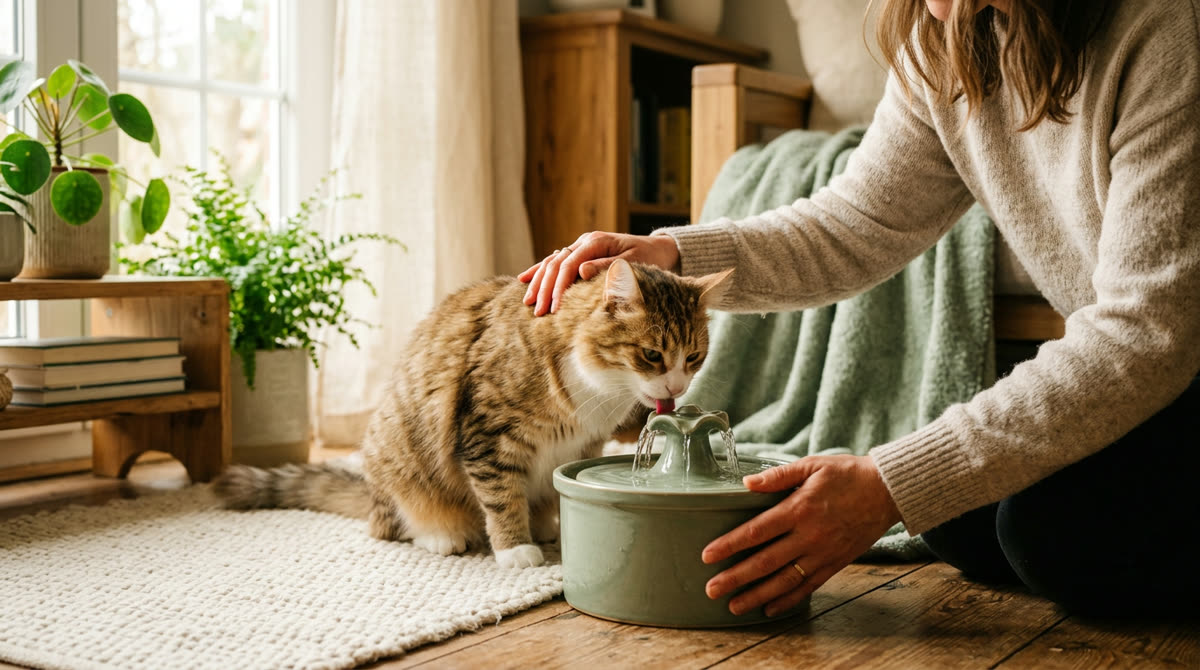
A cat water fountain can help cats that prefer moving water, but it is an optional preference test rather than a guaranteed hydration solution. Choose a stable model with accessible drinking surfaces, an adjustable gentle flow, and a pump that can be removed for cleaning, favoring designs without narrow channels you cannot reach with a brush. Set it on a waterproof mat in a quiet location near a suitable outlet, protect the cord from chewing, and follow the manufacturer’s electrical-safety instructions. Let your cat investigate with the pump switched off for a day or two if the design safely holds accessible water that way, then try the lowest flow while a familiar bowl remains nearby. If the motor hum, vibration, or splashing causes retreat or watchful behavior, turn it off and change the setup rather than carrying your cat over or dipping a paw into the water. Check the water level daily, refresh the water regularly, and fully disassemble and wash the fountain at least weekly—or more often if the manufacturer advises it or slime develops—because circulating water is not self-cleaning. Replace filters on the product’s schedule, often every 2–4 weeks depending on the model and use, and keep a separate bowl available permanently in case the pump stops or your cat changes its preference.
- Select quiet, adjustable flow and an easy-to-clean pump.
- Introduce the fountain gradually without forced interaction.
- Check water level and pump operation every day.
- Keep a conventional bowl available as a backup.
Good to know: A slimy surface signals that cleaning is overdue; changing the filter alone will not remove buildup from the reservoir, tubing, or pump.
- 7
Use flavor only when plain-water changes are not enough
If fresh bowls, better placement, and dietary moisture have not helped, a lightly flavored water option may interest some cats, but it should supplement rather than replace plain water. For a healthy cat without dietary restrictions, you can trial approximately 1 teaspoon of liquid from tuna packed in water with no added salt mixed into 100–200 milliliters of water, checking that the ingredients contain no seasonings or other additives. Another option is a cat-specific hydration product, but read its feeding directions and calorie content carefully because some products are treats rather than nutritionally complete foods. Avoid ordinary stock cubes, gravy, and seasoned broths, which may contain excessive salt or onion and garlic ingredients that are unsafe for cats. Do not use cow’s milk as a hydration strategy, and never add human sports drinks, electrolyte powders, essential oils, or supplements unless your veterinarian specifically recommends an appropriate product. Serve only a small amount of flavored water in a separate clean bowl, discard it within 1–2 hours or sooner in warm conditions, and wash the bowl afterward because food-containing water spoils faster than plain water. Stop if the flavoring causes digestive upset, reduces normal food intake, or makes your cat refuse plain water, and ask your veterinarian before offering it to a cat with a food allergy, prescribed diet, or chronic condition.
Good to know: Flavor is a short preference trial, not a reason to keep making water richer or saltier; many cats do better with a different bowl or added moisture in meals.
- 8
Troubleshoot avoidance one change at a time
Give each simple preference change around 3–5 days while maintaining familiar water access, and change only one major feature at a time so you can tell what actually helps. If your cat ignores a bowl, move it to a quiet spot along a regular walking route rather than repeatedly placing the cat beside it, since pressure can create an unpleasant association. If your cat paws at the water or tips the dish, try a heavier, broad-based bowl and a lower fill level; a cat that repeatedly spills water may leave itself without a usable supply. If one pet hovers nearby, add a visually separated station with more than one escape route, because several bowls lined up together still function as one guarded resource. For a cat that seeks a dripping tap, try a fountain with a similar gentle stream, but do not rely on an open faucet as the only source or allow access to sinks containing cleaner residue. If watery food is rejected, return to the last accepted consistency and try just half a teaspoon of added water, rather than withholding the regular meal until the cat gives in. Persistent apparent reluctance to drink, drooling, difficulty eating, or a clear fall in normal intake calls for veterinary advice rather than an endless series of new bowls, especially when appetite, energy, or urination also changes.
Good to know: Drinking often happens when nobody is watching; a short camera recording can reveal nighttime visits without making your cat feel observed or interrupted.
- 9
Maintain the routine and review the results
After 1–2 weeks, compare your notes with the baseline and keep the two or three changes your cat accepts most comfortably, rather than continuing to add gadgets or flavorings. Success means reliable access to appealing water, normal eating and behavior, and an appropriate overall moisture intake—not necessarily more visible trips to the bowl, especially after switching to wetter meals. Make fresh water part of morning and evening pet-care checks, wash bowls daily, and put fountain cleaning and filter changes on a calendar so the routine remains manageable. Watch litter-box output for changes from your cat’s usual pattern, remembering that clump size depends on the litter and cannot by itself confirm adequate hydration or rule out a medical problem. During hot weather, travel, or household disruption, add accessible stations and check them more frequently, and give pet sitters written instructions covering placement, cleaning, food moisture, and emergency contacts. If your efforts do not appear to improve a genuinely low intake, or if your cat starts drinking much more without an obvious dietary explanation, bring the food labels, intake notes, and behavior observations to your veterinarian. The safest approach to getting your cat drinking more water is a consistent, low-stress routine supported by moisture-rich meals where appropriate, with prompt professional help whenever thirst, urination, or general health changes.
- Review the routine after 1–2 weeks.
- Keep successful changes and remove unnecessary extras.
- Schedule daily bowl washing and regular fountain maintenance.
- Share intake records with your veterinarian when concerns persist.
Ask about this guide
Leave a comment or a question about your own pet and the Pawlito assistant replies right away with practical next steps.