How to Keep an Indoor Cat Active and Mentally Busy
Make indoor cat enrichment part of everyday life with safe climbing spaces, hunting games, food puzzles, and a routine your cat enjoys.
A calm, safety-first approachThis guide provides general education. Contact your veterinarian when symptoms are painful, persistent, or unusual.
- 1
Assess Your Cat’s Needs and Set a Baseline
Start your indoor cat enrichment plan by watching your cat for 2–3 days and noting when they naturally explore, chase, scratch, eat, and retreat to rest. Record which activities hold their attention and for roughly how long, because a cat that stalks a ribbon from behind furniture may prefer a different game from one that races after rolling balls. Consider age, mobility, confidence, and body condition when choosing activities: kittens often enjoy frequent short bursts, while older cats may do better with floor-level hunting and easy-access perches. Begin with two or three interactive sessions of 3–5 minutes each day, then adjust to your cat’s engagement rather than treating a time target as compulsory exercise. If your cat has known health or mobility concerns, ask your veterinarian about appropriate activity before introducing strenuous chasing or climbing. A sudden drop in activity, reluctance to jump, limping, appetite changes, or unusual hiding needs veterinary attention rather than a more exciting toy. Set one realistic starting goal, such as replacing five minutes of evening inactivity with a gentle hunting game, so you can build a routine that lasts.
- Note your cat’s most alert times.
- List favorite toys, textures, and hiding spots.
- Record comfortable jumping and climbing heights.
- Identify any recent changes in behavior.
Good to know: Long naps are normal for cats, and sleep alone does not mean your cat is bored. Look for changes from their usual behavior rather than comparing them with a younger or more energetic cat.
- 2
Build a Safe Climbing and Scratching Route
Create an inviting route through one frequently used room by combining a stable cat tree, a resting perch, a hiding place, and at least two scratching options. Choose a tree with a broad, sturdy base, anchor tall units as directed by the manufacturer, and use properly installed shelves rated to support your cat’s weight. Position an initial step roughly 8–12 inches above the floor if that suits your cat’s mobility, adding lower steps or a nonslip ramp for cats that struggle with jumping. Place a firm vertical scratcher tall enough for a full-body stretch near a sleeping area, and offer a horizontal cardboard scratcher to discover whether your cat prefers a different angle. Add a cardboard box with an entrance comfortably wider than your cat’s body, removing staples, tape, handles, and loose packing material before use. Keep landing surfaces clear and grippy, and avoid routes beside hot appliances, open toilets, unstable ornaments, or windows without secure protection. In a multicat home, provide separate perches and hiding options with more than one escape route where possible, because a valuable lookout stops being enriching if another cat can trap its occupant.
- Check furniture for wobbling or tipping.
- Secure shelves using appropriate fixings.
- Provide clear, nonslip landing areas.
- Offer vertical and horizontal scratching surfaces.
- Keep hiding places away from household hazards.
Good to know: Do not carry your cat onto a high shelf to make them use it. Encourage voluntary exploration from the lowest level, and make sure getting down is as easy as getting up.
- 3
Run Short Hunting Games Every Day
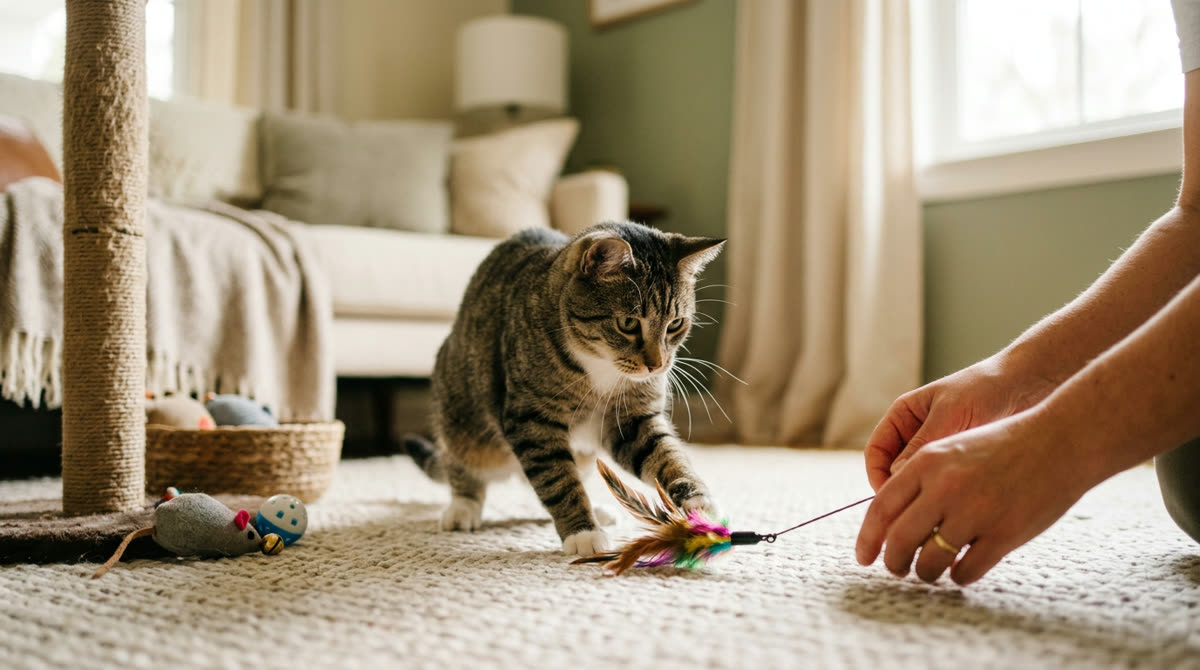
Use a wand toy to recreate a small hunting sequence: let your cat notice the target, stalk it, chase briefly, and finally catch it. Move the lure away from your cat in short, uneven bursts along the floor, pausing behind a box or around a corner for 5–10 seconds rather than waving it continuously in their face. Start with a 3–5-minute session and offer breaks, allowing an interested, comfortable cat to continue while ending earlier if they disengage or become tired. Let your cat catch the toy several times, then finish with a satisfying capture followed by a small portion of their normal meal to give the game a clear ending. Keep movements low and controlled until you know your cat’s abilities, since repeated high leaps, sharp turns on slippery floors, and sudden landings can cause injury. Never use your hands or feet as prey, and put wand toys, strings, feathers, and elastic attachments in a closed cupboard immediately afterward. Stop play if your cat pants, limps, seems distressed, or breathes unusually hard; seek urgent veterinary care for open-mouth breathing that persists after stopping or any obvious breathing difficulty.
- Move the toy away like fleeing prey.
- Include pauses for watching and stalking.
- Allow frequent successful catches.
- End with a capture and a little regular food.
- Store string-based toys out of reach.
Good to know: Physical toys provide a catchable reward that a laser cannot. If you use a laser, never aim it at eyes and finish by leading your cat to a real toy they can capture.
- 4
Turn Part of Mealtime Into a Puzzle
Set aside part of your cat’s measured daily food allowance for enrichment instead of adding puzzle rewards on top of their usual intake. For a beginner, place 5–10 pieces of their regular kibble in a clean, shallow muffin tray or a commercial puzzle with wide, uncovered compartments, keeping the rest of the meal readily accessible. Demonstrate once by moving a piece toward the edge, then let your cat investigate without holding their paw or repeatedly putting them back in front of the feeder. Once they retrieve food confidently over several sessions, increase just one challenge at a time, such as using a slow-rolling treat dispenser with a generously sized opening. For wet-food eaters, try a shallow lick mat or washable feeding puzzle designed for wet food under supervision, then promptly remove leftovers and wash the feeder according to its instructions. Keep treats to no more than 10 percent of daily calories unless your veterinarian advises otherwise, and count training rewards within that same allowance. Never withhold needed food to force puzzle use, and contact your veterinarian promptly if your cat eats noticeably less or refuses food, especially if they have an existing medical condition.
- Measure food before dividing it among activities.
- Start with visible, easy-to-reach rewards.
- Choose smooth, washable, food-safe products.
- Increase only one difficulty feature at a time.
- Keep a familiar feeding option available.
Good to know: Feed cats separately if one steals puzzle food or guards the feeding area. Enrichment should improve access and confidence, not create competition around meals.
- 5
Teach Simple Skills With Positive Reinforcement
Add mental exercise with one or two training sessions lasting 1–3 minutes, ideally when your cat is awake, relaxed, and interested in a small food reward. Start with a nose target by presenting a pet-safe target stick a few inches away and saying a consistent marker word, such as “yes,” the moment your cat voluntarily touches the tip. Deliver a tiny reward within about one second of the marker, using their normal food where practical so the lesson does not substantially increase daily calories. Repeat three to five times, ending while your cat still wants to participate, and gradually move the target a little farther away once they understand the task. Use targeting to invite your cat onto a low mat, through an open carrier, or around a simple floor-level obstacle, making each new challenge easy enough to succeed without physical pressure. Leave the carrier open with comfortable bedding between sessions so it becomes a familiar resting option rather than an object that only predicts stressful trips. If your cat walks away, freezes, lashes their tail, or repeatedly turns down rewards, stop and make the next session shorter or easier instead of repeating commands or using punishment.
Good to know: A marker word works well if a clicker startles your cat. Keep the sound quiet and consistent, and reward immediately so your cat can connect the marker with the behavior.
- 6
Offer Controlled Sensory Experiences
Provide a secure window-watching station with a stable bed or perch, shade, and an easy route away so your cat can choose when to observe outdoor movement. Keep windows closed unless they have a cat-safe barrier designed to prevent escape, because an ordinary insect screen may not withstand a leaning or lunging cat. Watch the first few sessions for relaxed observation versus agitation, and block the lower view or relocate the perch if outdoor cats trigger growling, pacing, or redirected aggression. Introduce scent enrichment by offering a washable catnip or silvervine toy for 5–10 minutes under supervision, recognizing that some cats show little interest and others become overstimulated. You can also offer a small pot of pesticide-free cat grass on a washable tray, while keeping toxic plants, particularly true lilies and daylilies, completely out of the home. Avoid essential oils, incense, and scented sprays as enrichment, since pleasant smells for people are not necessarily safe or comfortable for cats. If you want to add outdoor experiences, use a fully enclosed, escape-resistant catio or gradually introduce a well-fitted harness indoors first, maintaining supervision and discussing relevant parasite prevention with your veterinarian.
- Check window security before placing a perch.
- Provide shade and an easy retreat.
- Remove sensory items that cause agitation.
- Verify plant safety before bringing plants home.
Good to know: More stimulation is not always better. If watching birds or neighborhood cats leaves your cat persistently frustrated, switch to a quieter view and a catchable indoor toy.
- 7
Prepare Safe Activities for Alone Time
Before leaving your cat alone with a new enrichment item, supervise several sessions to learn whether they chew, shred, swallow, or become caught in any part of it. Set out two or three tested options, such as a sturdy ball too large to fit fully in the mouth, an intact track toy with a securely captive ball, and a roomy cardboard box without loose materials. Reserve strings, yarn, ribbons, hair ties, feather attachments, plastic bags, and toys with detachable small parts for situations where they can be safely controlled or excluded altogether. Use a purpose-built timed feeder for a portion of your cat’s meal if a predictable food event helps break up a long day, following the manufacturer’s storage instructions and using suitable cooling for perishable food. Rotate a selection of toys every 3–4 days instead of covering the floor with everything you own, while leaving familiar favorites available if your cat uses them consistently. Inspect accessible toys daily for cracked plastic, exposed wire, loose stitching, damaged battery compartments, and missing pieces, replacing anything that can no longer be used safely. For absences beyond a normal workday, arrange appropriate in-person care rather than relying on gadgets, because toys and automatic feeders cannot check health, refresh the environment, or provide responsive social contact.
- Test every new item while you are present.
- Leave only intact, appropriately sized toys.
- Secure batteries and electrical cords.
- Keep food, water, litter, and resting areas accessible.
- Remove damaged items immediately.
Good to know: If you suspect your cat swallowed string or a toy part, contact a veterinarian immediately rather than waiting for symptoms. Never pull string protruding from the mouth or anus, because doing so can cause serious internal injury.
- 8
Troubleshoot Disinterest and Overexcitement
If your cat ignores an activity, change one feature at a time so you can identify whether timing, texture, movement, location, or difficulty is the problem. Try a two-minute game before a usual meal or during an evening alert period, moving a small lure behind cover rather than expecting a stationary toy in an open room to be exciting. For food puzzles, return to an uncovered compartment with visible food; for climbing, add a lower stable step; and for training, reward simply looking toward the target before asking for a touch. If play turns into ankle ambushing or biting, become still when safe, avoid grabbing or wrestling, and use distance or a barrier to disengage before scheduling a calmer toy-based session later. Watch for an escalating combination of tense posture, flattened ears, forceful tail movements, and hard biting, and end the interaction without scolding when your cat appears overwhelmed. In multicat homes, try separate play sessions behind a closed door because a quieter cat may avoid participating while a bolder cat controls the toy or space. Arrange a veterinary assessment for persistent withdrawal, new aggression, reduced grooming, appetite changes, or a sudden loss of interest, since behavior changes should not automatically be attributed to boredom.
Good to know: Quiet watching can be part of play, especially for cautious cats that stalk before pouncing. Give your cat 10–20 seconds to observe a lure instead of immediately switching toys or pushing it closer.
- 9
Maintain a Balanced Routine and Review Progress
Build a simple daily schedule around predictable opportunities rather than nonstop stimulation, such as a five-minute morning hunt followed by breakfast, a safe midday puzzle, and a five-minute evening game. Add a brief training session on days your cat enjoys it, but preserve quiet sleeping areas and never wake your cat repeatedly just to meet an activity target. After each supervised session, put away risky toys, remove uneaten perishable food promptly, and leave fresh water and an undisturbed resting place available. Track participation for two weeks using practical notes such as which game prompted stalking, how easily a puzzle was solved, and whether your cat settled comfortably afterward. Review the plan weekly and change one underused activity, gradually extending a session by a minute or two only when your cat remains comfortable and interested. If weight management is a goal, ask your veterinarian for an appropriate feeding and monitoring plan rather than sharply reducing food or assuming extra play alone will produce weight loss. Successful indoor cat enrichment gives your cat daily choices to hunt, explore, scratch, learn, and rest, with adjustments as their interests, household circumstances, and physical abilities change.
- Keep daily play opportunities predictable.
- Clean feeding puzzles after use.
- Log favorite activities for two weeks.
- Review difficulty and toy condition weekly.
- Protect uninterrupted rest and retreat time.



Ask about this guide
Leave a comment or a question about your own pet and the Pawlito assistant replies right away with practical next steps.