How to Keep Indoor Cats Happy and Entertained
Prevent boredom and behaviour problems with an enriched indoor environment your cat will genuinely enjoy.
- Written by
- Pawlito Editorial Team · AI-assisted guide
- Professional review
- Not yet reviewed by a veterinarian
- Published
- Last updated
In this guide (8 steps)
Step 1: Understand what indoor cats miss
Outdoor life gives cats hunting, climbing, exploring and territorial patrols. Indoor cats still have all these instincts but no outlet, which leads to boredom, weight gain and behaviour problems like night-time zoomies or furniture destruction. Enrichment is not a luxury — it is a welfare need. The good news is that a few daily habits meet almost all of these needs indoors.
Step 2: Play hunt games every day
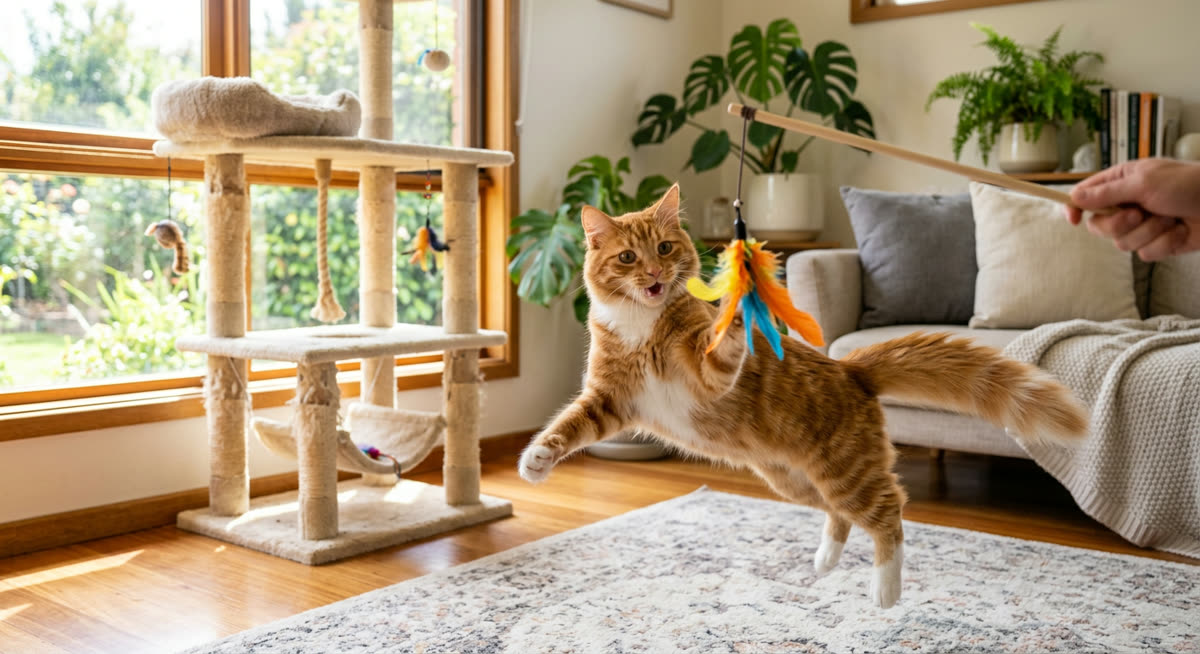
Wand toys that mimic prey are the single best enrichment tool. Move the toy like a real creature — darting, hiding, pausing — rather than waving it in your cat's face. Two sessions of ten to fifteen minutes daily, ideally before meals, replicate the natural hunt-eat-sleep cycle. Always let your cat catch the toy at the end to avoid frustration.
Good to know: End each play session with a small meal or treat to complete the hunting sequence.
Step 3: Create vertical territory
Cats feel safe up high and use vertical space to expand their territory. A tall, sturdy cat tree near a window is ideal. Wall shelves arranged as climbing routes work brilliantly in small homes. Give each cat in a multi-cat home their own high spot to prevent conflict.
Step 4: Make windows into entertainment
A window perch with a view of birds and passing life is cat television. Place a bird feeder outside the window if possible, positioned so your cat can watch but birds stay safe. Open windows slightly with secure screens so your cat can smell the outdoors. Rotate which curtains are open to vary the view.
Step 5: Feed the hunter, not the bowl
Ditch the food bowl for part of the daily ration. Puzzle feeders, treat balls and food hidden around the house make your cat work for meals as nature intended. Start easy and increase difficulty as your cat learns. This slows eating, aids weight control and provides genuine mental work.
- Puzzle feeders for dry food
- Snuffle mats or cardboard tubes with hidden kibble
- Rotate feeder types weekly to keep them interesting
Step 6: Rotate toys and offer novelty
Cats bore of toys left out constantly. Keep most toys in a cupboard and rotate a few each week so old toys feel new again. Cardboard boxes, paper bags with handles removed, and tunnels are free favourites. Catnip or silvervine toys add variety for the roughly two thirds of cats who respond to them.
Step 7: Consider safe outdoor access
A secure cat enclosure or 'catio' gives indoor cats fresh air and stimulation without the risks of roaming. Some cats enjoy harness training for supervised garden time, introduced gradually over weeks. Even a secure balcony with cat netting adds enrichment. Never let an indoor-only cat roam free suddenly — they lack street smarts.
Step 8: Watch for signs of boredom or stress
Over-grooming, lethargy, overeating, aggression or litter tray problems can all signal an under-stimulated or stressed cat. Increase play and enrichment first, and track changes over two weeks. If problems persist or your cat seems unwell, see your vet to rule out medical causes. A genuinely enriched indoor cat is relaxed, playful and a healthy weight.
Good to know: Fifteen minutes of proper interactive play beats hours of passive toys.
This guide was drafted with AI assistance and published by the Pawlito team. It has no formal source list yet. Spotted an error? Tell us and we'll correct it. Read our editorial policy.
Ask about this guide
Leave a comment or a question. Comments are public, so use a first name only and don't include emails, phone numbers or addresses. An automated assistant may reply straight away with general suggestions — it can't diagnose your pet.