How to Bond a Pair of Rabbits Step by Step
Make bonding rabbits safer with a step-by-step guide to choosing partners, neutral introductions, reading behavior, and building a lasting bond.
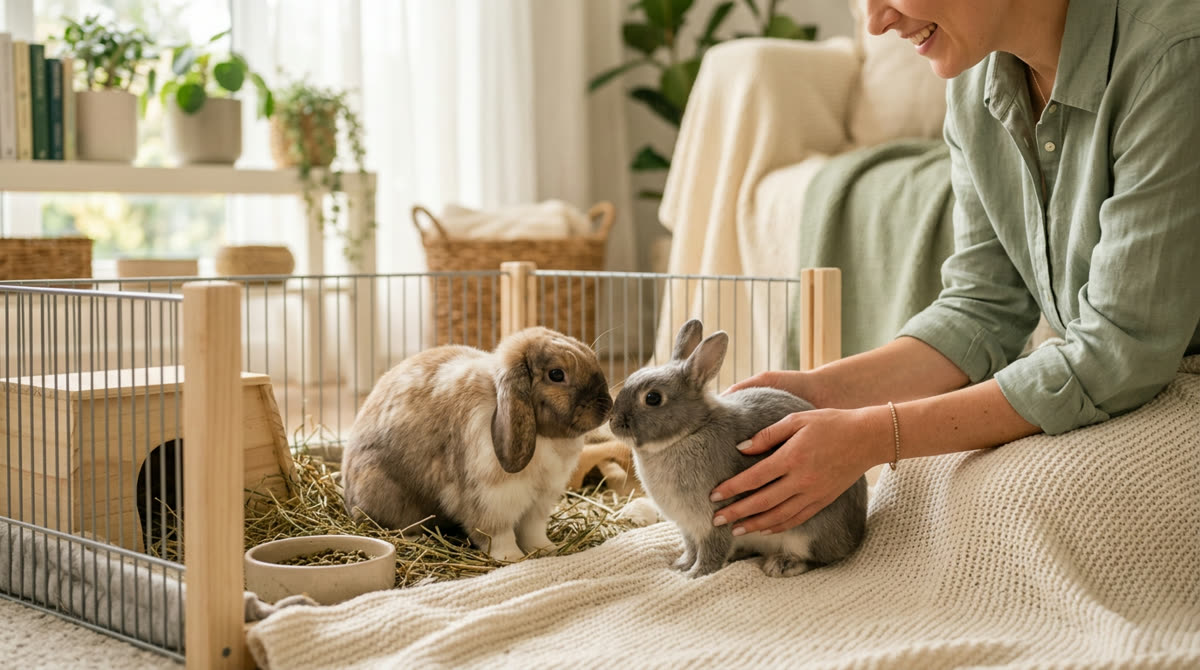
A calm, safety-first approachThis guide provides general education. Contact your veterinarian when symptoms are painful, persistent, or unusual.
- 1
Choose a Compatible Partner and Set Realistic Expectations
Bonding rabbits means helping two individual rabbits develop a trusting relationship so they can eventually share a home, rather than simply putting them in the same enclosure. Start with a rabbit-experienced rescue that offers supervised introductions or matchmaking, because personality and observed compatibility matter more than matching breed, size, or coat color. A neutered male and spayed female are often a straightforward pairing, although same-sex pairs can also form strong bonds when both rabbits are neutered and compatible. Choose a partner with an activity level and physical ability that suit your rabbit, especially if one is elderly, has limited mobility, or is much smaller than the other. Do not assume that littermates or two affectionate babies will remain compatible after puberty, since hormonal changes can disrupt an apparently peaceful relationship. Plan for the process to take several weeks to a few months, with some pairs needing longer and a small number never becoming suitable housemates. Before committing, arrange enough space and equipment to keep both rabbits safely and comfortably in separate housing for as long as necessary.
- Ask a rescue about supervised matchmaking.
- Prioritize temperament over appearance.
- Discuss any history of fighting or injury.
- Prepare a long-term separate-housing backup.
Good to know: A rabbit charging at a newcomer through its home enclosure does not prove the pair is incompatible; territorial encounters are not a substitute for neutral introductions.
- 2
Complete Health Checks, Neutering, and Recovery
Book a veterinary check for both rabbits before direct introductions, and discuss dental health, pain, parasites, vaccination needs, and any recent changes in appetite or droppings. Both rabbits should normally be spayed or neutered before bonding, because reproductive hormones can drive mounting, spraying, territorial defense, and fighting. Wait until surgical wounds have healed and your veterinarian has cleared each rabbit, commonly allowing around 4–6 weeks after surgery for recovery and hormonal behavior to settle. A recently castrated male can remain fertile for up to 6 weeks, so never allow contact with an unspayed female during that period, and do not start bonding an intact pair. For a newly acquired rabbit, ask your veterinarian whether a quarantine period is needed; a separate room for roughly 2–4 weeks is commonly recommended, but the appropriate duration depends on the rabbit's origin and health risks. During quarantine, use separate bowls, litter tools, and bedding, wash your hands between rabbits, and avoid exchanging scent items until your veterinarian considers it safe. Postpone introductions and contact a veterinarian if either rabbit develops discharge, diarrhea, reduced appetite, unusual lethargy, or other signs of illness, since discomfort can make social contact both unsafe and misleading.
- Confirm both rabbits' sex and neuter status.
- Obtain clearance after surgery.
- Review locally recommended vaccinations.
- Complete any advised quarantine before scent swapping.
Good to know: If surgery is unsuitable because of an individual rabbit's health, ask a rabbit-savvy veterinarian and an experienced rescue for a tailored plan rather than attempting ordinary bonding sessions.
- 3
Prepare Safe Separate Housing and a Neutral Meeting Area
After quarantine, set up two secure living areas where the rabbits can become familiar with each other without being able to bite through the dividing fence. Use double barriers with about 6 inches, or 15 centimeters, between them, increasing the gap if either rabbit can reach across, and make sure neither can jump or push through. Each rabbit needs its own hay, water, litter tray, resting place, enrichment, and daily exercise; a small carrier or cage is not suitable housing while bonding progresses. Choose an introduction area that neither rabbit normally occupies, such as a gated section of a spare room, rather than the resident rabbit's pen or favorite rug. For an initial meeting, a neutral pen around 4 by 6 feet, or 1.2 by 1.8 meters, can work if it gives both rabbits room to move away and lets you reach every corner quickly. Cover slippery flooring with a flat washable rug or tightly secured fleece, remove cables and narrow gaps, and avoid single-entrance hides where one rabbit could trap the other. Place hay in two locations and provide stable water bowls, then keep a towel, a rigid separation panel, and individual transport carriers nearby before bringing either rabbit in.
- Double-fence neighboring enclosures.
- Secure a nonslip floor.
- Remove dead ends and single-door hides.
- Provide duplicate hay and water stations.
- Keep a barrier and towel within reach.
Good to know: Do not use a slippery bathtub, a cramped box, or a shared car ride to force closeness; fear-driven stillness is not reliable evidence of a bond.
- 4
Build Familiarity Without Direct Contact
Let the rabbits settle into their separate spaces for several days, watching for relaxed eating, grooming, exploring, and resting rather than demanding immediate interest in each other. Begin with their enclosures far enough apart that both behave normally, then gradually move them closer while maintaining the protective gap between barriers. Once health precautions are complete, exchange a small handful of clean-used hay, a resting mat, or another lightly scented item once daily so each rabbit encounters the other's smell without a confrontation. If scent exchange causes persistent agitation or marking, use a smaller item or pause for a day instead of increasing exposure. Offer a portion of each rabbit's usual leafy greens at the same time, initially several feet from the divider and gradually nearer only if both remain comfortable. Brief sniffing followed by ordinary activities is more useful progress than prolonged staring, fence biting, lunging, or frantic pacing. Move to a face-to-face introduction when both rabbits can spend several consecutive observation periods of about 15–30 minutes near one another without sustained agitation, recognizing that some rabbits need a longer preparation phase.
Good to know: Do not restrict food to make the rabbits interact over it; unlimited grass hay should remain available throughout the bonding process.
- 5
Run Short, Closely Supervised Introductions
Schedule the first meeting when you can give it uninterrupted attention, ideally with a second calm adult present and neither rabbit already frightened by travel, noise, or handling. Bring both rabbits into the prepared neutral area at approximately the same time, placing them apart and allowing them to approach rather than holding their faces together. Start with about 5–10 minutes if behavior remains calm, and stay within immediate reach instead of watching from another room or relying on a camera. Allow sniffing, cautious exploration, eating hay, and even ignoring one another, because peaceful coexistence is a valuable early goal. Scatter a little hay or place two small portions of familiar greens well apart, but avoid a single high-value treat or narrow feeding spot that encourages competition. End a successful first session while both rabbits are settled, using a panel to separate their paths before returning them to their individual homes rather than grabbing an excited rabbit. Repeat once daily at first, or twice if both rabbits recover readily and remain relaxed, making decisions from their behavior instead of following a deadline.
- Keep the first calm meeting to about 5–10 minutes.
- Supervise at arm's reach.
- Let both rabbits choose whether to approach.
- Reward calm coexistence, not forced contact.
Good to know: Keep children and other pets outside the bonding area, and do not leave the pair together while you fetch supplies, answer the door, or check your phone.
- 6
Read Their Behavior and Interrupt Escalation
Encouraging signs include loose body posture, eating in each other's presence, grooming themselves, resting nearby, and eventually grooming one another, although mutual grooming is not required during the first sessions. A brief grooming request with the head lowered, a short rear-mounting attempt, or one quick nip without pursuit may occur, but these behaviors still need close observation rather than automatic acceptance. Calmly interrupt mounting that targets the other rabbit's head, since the rabbit underneath can bite the genitals, and interrupt any mounting that is prolonged or clearly distressing. Step in when chasing persists, one rabbit repeatedly flees or hides, or behavior escalates to tense circling, lunging, boxing, biting, or forceful fur pulling. Separate immediately if the rabbits lock together, roll, or form a tight fighting circle, using the rigid panel or a towel to interrupt contact without putting bare hands between their mouths. Never let rabbits fight to 'sort it out,' punish them, spray them with water, or pin one down for the other to investigate. Once safely separated, check both rabbits carefully for wounds, including beneath thick fur, and contact a veterinarian promptly for any bite, bleeding, swelling, lameness, or suspected eye or genital injury.
- Continue: relaxed eating, exploring, and resting.
- Interrupt: head mounting or repeated pursuit.
- Separate: boxing, biting, or tight circling.
- Seek veterinary care for wounds or suspected injury.
Good to know: Thick gloves are not bite-proof, and rabbit skin tears easily; prioritize a solid barrier over reaching in or pulling fighting rabbits apart.
- 7
Extend Calm Sessions and Troubleshoot Setbacks
After several calm meetings, increase session length in small increments, such as from 10 to 15 minutes and then to 20–30 minutes, without increasing both duration and space at the same time. Progress toward one-hour and then multi-hour sessions only when both rabbits can eat, rest, and move around without repeated intervention, since tolerating five minutes does not establish readiness to live together. Use a simple log to record session length, location, relaxed behaviors, chasing, mounting, and each rabbit's appetite afterward so you can spot patterns rather than relying on a single good moment. If tension develops, return to the last arrangement and duration that worked, checking for triggers such as a guarded food bowl, a slippery patch, a noisy appliance, or too little room to retreat. After a genuine fight, stop direct contact, assess injuries, and allow a recovery period in secure separate housing before discussing a slower restart with a rabbit-experienced rescue or veterinarian. Seek professional help if meetings repeatedly produce aggression, either rabbit remains chronically fearful, or progress stalls despite careful adjustments, because a different partner may ultimately be kinder. Never substitute stressful car rides, loud noises, forced restraint, or an unsupervised overnight session for gradual bonding; apparent submission under stress can unravel as soon as the rabbit feels safe.
Good to know: A sudden setback after previously relaxed sessions can reflect pain or illness rather than a relationship problem, so arrange a veterinary check if behavior changes unexpectedly.
- 8
Move Into a Shared Home Only When Both Are Ready
Consider shared housing only after the pair has completed repeated long, uneventful sessions that include resting, feeding, and naturally active periods, with neither rabbit guarding resources or continually avoiding the other. Build toward continuous supervised time in the neutral setup, including evening and overnight activity, and arrange adult supervision rather than treating one calm afternoon as proof they are safe alone. Many bonding plans use at least 24–48 hours of peaceful continuous observation before routine unsupervised living, but this is a checkpoint rather than a guarantee, and uncertain pairs need more time or expert guidance. Prepare the permanent enclosure by removing soiled bedding, cleaning surfaces with a rabbit-safe product used according to its label, rinsing and drying as directed, and rearranging furnishings to reduce the resident rabbit's territorial associations. For two average-sized rabbits, aim for a permanently accessible living and exercise area of at least about 10 by 6.5 by 3.3 feet, or 3 by 2 by 1 meter, with more space for larger or especially active rabbits. Initially provide two generous litter trays, at least two hay stations, two water points, and shelters with two exits, then introduce both rabbits together and resume close observation. Keep the separate-housing equipment ready, and if persistent chasing, guarding, or fighting appears in the new home, separate safely and return to a previously successful neutral stage rather than leaving them to adjust alone.
- Confirm relaxed behavior across long sessions.
- Clean and rearrange the permanent enclosure.
- Duplicate litter, hay, water, and resting options.
- Monitor closely after the move.
- Retain a safe separation setup.
Good to know: If you cannot arrange supervision through the transition, postpone shared overnight housing; convenience should not determine when rabbits are ready.
- 9
Protect the Bond With Daily Checks and Follow-Up
During the first 1–2 weeks of shared living, check the pair frequently and watch each rabbit individually at feeding times to confirm that both can reach hay, water, litter trays, and resting places without being displaced. Continue offering multiple resources long term, along with daily enrichment such as hay-filled cardboard boxes with two openings, safe chew items, and room to run, because companionship does not replace exercise or choice. Record each rabbit's weight weekly on the same pet or baby scale, and contact your veterinarian about an unexplained downward trend or a change in eating, droppings, grooming, or movement. If either rabbit stops eating, produces markedly fewer or no droppings, seems hunched or painful, or becomes unusually lethargic, stop bonding work and contact a rabbit-savvy veterinarian immediately rather than waiting until the next day. For a securely bonded pair, ask the veterinary clinic whether the companion can attend appointments and stay nearby during treatment, since unnecessary separation and unfamiliar smells can sometimes unsettle the relationship. Follow veterinary instructions when illness, surgery, or injury requires separation, using protected adjacent housing only when medically appropriate and never forcing a reunion with a recovering rabbit. Maintain the relationship by responding early to new guarding or aggression, seeking veterinary assessment for abrupt behavioral changes, and remembering that successful bonding is shown by ongoing comfort and freedom to behave normally, not by constant cuddling.
- Check both rabbits' appetite and droppings daily.
- Weigh each rabbit weekly.
- Keep duplicate resources available.
- Plan veterinary visits around the bonded pair.
- Investigate sudden changes in behavior.

Ask about this guide
Leave a comment or a question about your own pet and the Pawlito assistant replies right away with practical next steps.