How to Set Up a Hamster Cage Properly
Build a safe, enriching hamster home with deep bedding, a suitable wheel and a practical layout that supports natural behaviour.
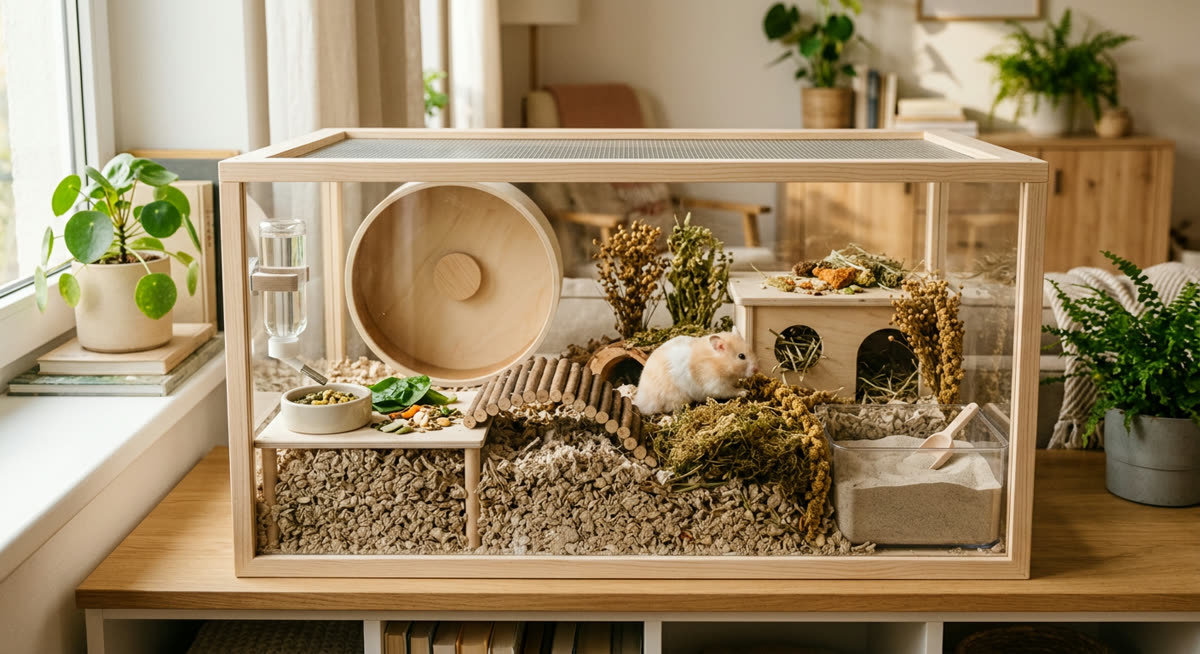
A calm, safety-first approachThis guide provides general education. Contact your veterinarian when symptoms are painful, persistent, or unusual.
- 1
1. Choose a spacious, escape-proof enclosure
Choose an enclosure with at least 100 cm by 50 cm of continuous internal floor space, and go larger wherever possible. Measure the usable base rather than the widest outside edges, and do not count shelves or connecting tubes towards this minimum. Look for enough height to accommodate at least 20 cm of bedding, ideally 25–30 cm or more across a substantial area, alongside an appropriately sized wheel. A glass tank with a secure mesh lid or a well-ventilated, purpose-built enclosure can work, provided its fittings cannot be chewed loose. If choosing a barred cage, check that the gaps suit your hamster’s size, using spacing no wider than about 6 mm for very small dwarf hamsters. Set up a separate enclosure for each hamster, as Syrian and Chinese hamsters must live alone and dwarf hamsters can also fight, making individual housing the safest choice.
- At least 100 cm × 50 cm of internal floor space
- Solid base with room for deep bedding
- Secure doors, lid and fastenings
- Generous ventilation without escape gaps
- One hamster per enclosure
Good to know: Mark the enclosure’s footprint on the furniture with paper before buying it, then check that you can still open the lid comfortably.
- 2
2. Position, clean and safety-check the empty cage
Place the enclosure on a sturdy, level surface that supports its entire base and cannot be knocked by children or other pets. Choose a quiet room away from direct sunlight, radiators, draughts, televisions and speakers, aiming for a stable temperature of roughly 18–24°C. Keep the cage away from cooking fumes, smoke, aerosol sprays and scented products, and make sure cats and dogs cannot reach it. Wash the empty enclosure and washable accessories with warm water and a small amount of mild, unscented washing-up liquid, then rinse thoroughly and dry completely. Inspect every surface for sharp edges, exposed staples, splinters and accessible glue or tape before adding anything. Close and gently test each latch, and check that bedding or nearby objects will not block the ventilation.
- Stable surface with full base support
- No direct sun, draughts or heat sources
- Clean, rinsed and completely dry surfaces
- No sharp edges or loose fittings
- Lid and doors securely fastened
- 3
3. Install stable supports and deep burrowing bedding
Before adding bedding, place secure platforms or supports on the enclosure floor wherever the wheel, sand bath or other heavy objects will sit. These supports must remain stable when your hamster tunnels underneath, without creating narrow gaps where it could become trapped. Fill a substantial area with at least 20 cm of low-dust, unscented paper bedding, ideally building up to 25–30 cm or more where the enclosure allows. Gently compress the bedding in layers so that it holds burrows, while keeping ventilation openings clear. Avoid cedar, untreated pine shavings, scented bedding, cat litter and cotton-wool-style nesting material, including products labelled as fluffy or digestible. Add torn strips of plain, unscented toilet tissue for nest building, and preserve some clean, familiar bedding if your hamster is moving from an existing home.
- Heavy equipment supported from below
- Deep, low-dust, unscented bedding
- Gently compressed layers for burrowing
- Plain toilet tissue for nesting
- No cotton wool or fluffy nesting fibres
Good to know: Keep the deepest bedding at one end and the wheel on a stable platform at the other, rather than making the whole cage shallow to fit equipment.
- 4
4. Fit a wheel that allows comfortable running
Choose an upright wheel with a continuous, solid running surface, avoiding wire mesh, rungs and scissor-like supports that could catch feet or limbs. As a starting point, look for a wheel around 28–30 cm or larger for a Syrian hamster and around 20–25 cm or larger for a dwarf hamster, adjusting for the individual’s size. Your hamster should be able to run with its back straight and head in a natural position rather than curved upwards. Secure the wheel to a suitable fixing or stable platform, leaving enough clearance that neither bedding nor nearby accessories can jam it. Spin it by hand to check that it turns freely without wobbling, and inspect any gaps around the axle or stand for trapping risks. Once your hamster begins using it, reassess the fit and choose a larger or more suitable model if its posture looks cramped or it struggles to control the wheel.
Good to know: Check wheel clearance again after your hamster has dug around it, as displaced bedding can stop an otherwise well-fitted wheel.
- 5
5. Add sheltered routes, hides and a sand bath
Provide a roomy, dark sleeping hide, ideally a multi-chamber design with an open base over deep bedding, plus additional shelters around the enclosure. Check that entrances and tunnels comfortably accommodate your hamster with full cheek pouches, and avoid narrow tubes or openings that could trap it. Arrange plain cardboard tunnels, hamster-safe wooden shelters and untreated chew items to create covered routes between the nest, wheel and feeding area. Keep the layout mostly at ground level, avoiding tall climbing structures, steep ramps and exposed shelves where a fall could cause injury. Add a stable sand bath containing unscented, low-dust sand specifically suitable for hamsters, not fine bathing dust or sand containing added calcium or fragrance. Make the bath large enough for your hamster to turn and roll, and never bathe your hamster in water as part of routine grooming.
- Dark sleeping hide over deep bedding
- Several sheltered routes and resting places
- Wide tunnels without trapping points
- Stable bath with suitable low-dust sand
- Safe chew items without paint or varnish
Good to know: Use an open-bottomed cardboard box with generously sized doorways as an inexpensive temporary hide, replacing it if it becomes wet or heavily chewed.
- 6
6. Set up reliable food and water stations
Provide fresh drinking water in a securely fitted bottle or a small, heavy, shallow bowl on a stable platform away from loose bedding. If using a bottle, check its flow by touching the spout and looking for a droplet, then confirm that your hamster can reach it without stretching awkwardly. Keep the water source your hamster already knows during the move, and provide both options initially if you are changing from a bottle to a bowl or vice versa. Choose a complete hamster food appropriate to your hamster’s species and life stage, using its feeding guidance as a starting point and asking your vet if you are unsure. Put some food in a small dish initially so that it is easy to find, and scatter part of the dry ration through accessible bedding to encourage foraging once your hamster settles. Offer only small amounts of hamster-safe fresh food and remove uneaten fresh pieces before they spoil, checking accessible stores without dismantling the nest.
- Fresh water within comfortable reach
- Bottle flow checked or bowl kept clear
- Complete food suitable for the hamster
- Some dry food available for foraging
- Uneaten fresh food removed promptly
- 7
7. Introduce your hamster quietly
Complete the setup before bringing your hamster over, then perform a final check of the lid, equipment stability, water supply and accessible gaps. Transfer your hamster using a secure carrier or a small container it can walk into, rather than chasing it or lifting it by the scruff. If the carrier fits safely inside the enclosure, place it on a stable surface, open it and allow your hamster to come out at its own pace. Otherwise, use the small container to lower your hamster gently to bedding level, keeping the transfer enclosed against escape. Keep the room quiet and avoid unnecessary handling or rearranging for the first few days, while still checking food, water and general wellbeing daily. Begin gentle interaction when your hamster is awake and emerging voluntarily, offering a treat at ground level without reaching into its sleeping nest.
Good to know: Introduce your hamster in the evening when it is naturally more likely to be awake, rather than waking it for the move.
- 8
8. Troubleshoot the layout and watch for health concerns
Observe your hamster when it is naturally awake, checking whether it can move freely, reach water, enter hides and use the wheel comfortably. If the wheel jams, a bowl becomes buried or a heavy accessory shifts, correct the support or position promptly without stripping out the whole enclosure. Treat persistent bar chewing, repeated escape attempts or repetitive pacing as reasons to review floor space, bedding depth, shelter and disturbance rather than simply adding more toys. Do not punish these behaviours, cover the cage in a way that restricts airflow or add a companion as a solution. Contact your vet promptly if your hamster stops eating, develops diarrhoea or a wet, dirty rear, seems unusually lethargic, or shows a sudden change in movement or behaviour. Seek urgent veterinary help for breathing difficulty, collapse, serious injury or a hamster that is unexpectedly cold and unresponsive, rather than assuming it is asleep or attempting home treatment.
- 9
9. Maintain the cage without removing all familiar scent
Check water, food, wheel movement, enclosure security and your hamster’s wellbeing every day, refreshing drinking water and cleaning its container daily. Remove wet bedding and obvious soiling from toilet areas as needed, replacing only what you take out with fresh bedding. Sift waste from the sand bath regularly and replace sand when it becomes damp, dirty or smelly. Check accessible food stores for spoiled fresh items, but leave clean, dry stored food and the sleeping nest undisturbed wherever possible. Carry out larger cleans in sections according to the enclosure’s condition, retaining some clean, dry old bedding and avoiding routine complete strip-outs unless contamination or veterinary advice makes one necessary. During disruptive cleaning, place your hamster in a secure, ventilated carrier with familiar bedding and a hide, then return it only when surfaces are dry and the equipment is safely back in place.
Good to know: Keep a simple daily check beside the cage for water, wheel and wet bedding so that small problems are caught before they become hazards.



Ask about this guide
Leave a comment or a question about your own pet and the Pawlito assistant replies right away with practical next steps.