How to Stop Your Dog Jumping on Guests
Turn chaotic door greetings into calm hellos with management, an incompatible behavior, and consistent rules everyone follows.
A calm, safety-first approachThis guide provides general education. Contact your veterinarian when symptoms are painful, persistent, or unusual.
- 1
Understand why dogs jump
Jumping is a natural greeting behavior for dogs — in the canine world, face-to-face contact is how friends say hello, and your dog is simply trying to reach your guest's face. The problem is that jumping works: guests react with pushing, squealing, or eye contact, and every one of those reactions is attention, which rewards the behavior. Even negative attention like scolding can reinforce jumping because the dog got exactly what it wanted — engagement. The first step to fixing it is accepting that your dog isn't being dominant or naughty; it's being a normal, social dog using a strategy that has always paid off. Once you remove the payoff and teach a better way to greet, the jumping fades quickly.
- Jumping = greeting behavior aimed at the face
- Any reaction — even scolding — can reward it
- Consistency from everyone is the key to success
- 2
Manage the doorway before training starts
Training fails when the dog keeps practicing the wrong behavior between sessions, so management comes first. Before guests arrive, put your dog on a leash, behind a baby gate, or in another room with a chew toy so it physically cannot rehearse jumping. Keep a treat jar by the front door so you are never caught unprepared. A leash is the simplest tool: stand on it or hold it so the dog can approach but cannot launch. This isn't a forever solution — it's a safety net that prevents rehearsal while the new behavior is being built. Most dogs need several weeks of managed greetings before they're reliable off-leash at the door.
- Leash, baby gate, or separate room before the doorbell rings
- Treat jar by the door for instant rewards
- Prevent rehearsal — every successful jump sets training back
Good to know: Text guests before they arrive: 'When you come in, ignore the dog completely until it's sitting — I'll tell you when to say hello.'
- 3
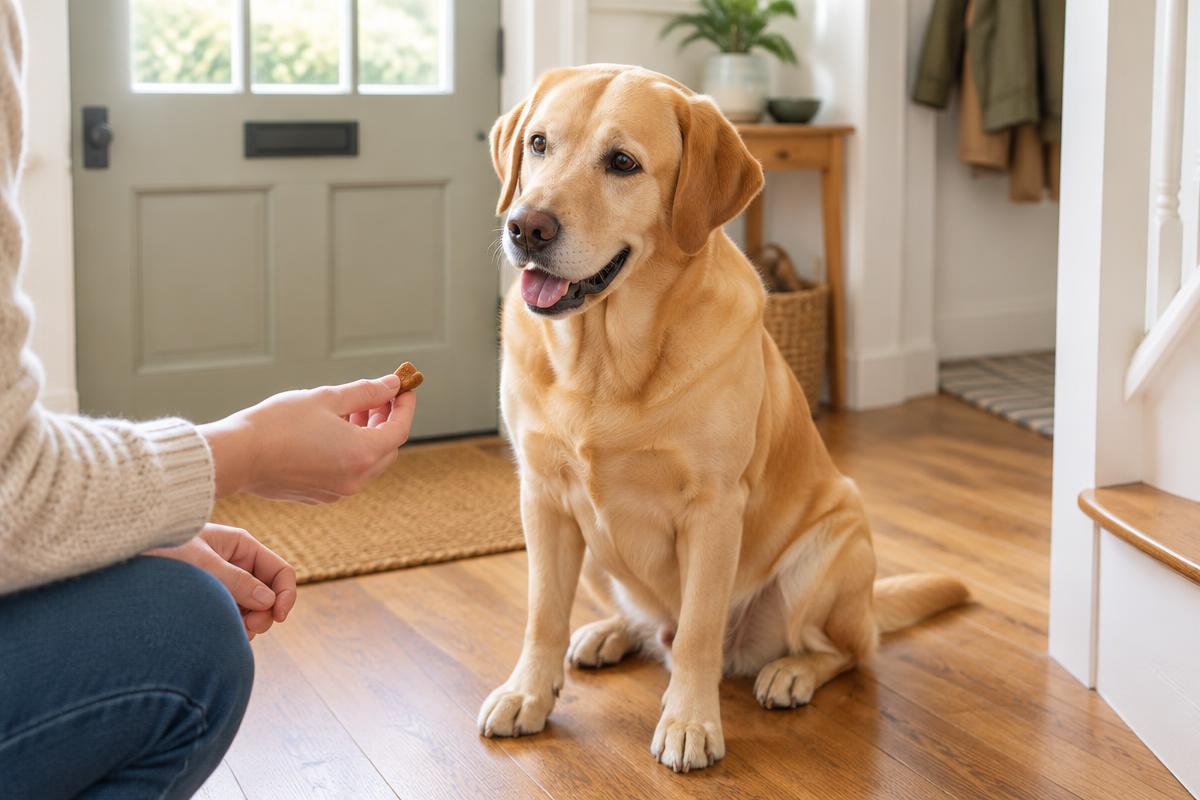
Teach 'sit' as the new greeting behavior
A dog cannot sit and jump at the same time, which makes 'sit' the perfect replacement behavior. Practice in boring conditions first: ask for a sit at the door with no guest present, reward generously, and repeat until it's instant. Then add the doorbell sound as a cue — ring it, ask for a sit, reward, and release. The goal is to flip the doorbell from a trigger for chaos into a cue to sit. Keep sessions to three or four repetitions so the dog stays successful and engaged. Once the dog offers a sit automatically when the bell rings, you're ready to add real people to the picture.
- Sit is physically incompatible with jumping
- Pair the doorbell with the sit cue in practice
- Short sessions of 3–4 reps work best
- 4
Rehearse with a helper before real guests
Before exposing your dog to actual visitors, run rehearsals with a family member or friend playing the role of guest. The helper knocks, enters, and approaches only while the dog is sitting; the moment four paws leave the floor, the helper turns and walks back out the door. This teaches the dog the rule with total clarity: sitting makes people approach, jumping makes them disappear. Repeat the entry five to ten times in one session — most dogs figure out the pattern within the first few tries. Rehearsals let you control the difficulty, which real visits never do, so invest in several before expecting success with genuine guests.
- Helper approaches only while the dog sits
- Jump = person leaves immediately
- 5–10 entries per session builds the pattern fast
- 5
Coach your guests on the rules
Your dog will only succeed if every human it meets follows the same script, so brief your guests before they step inside. Ask them to ignore the dog completely on entry — no eye contact, no talking, no touching — until the dog is sitting calmly. Once it's seated, they may greet it calmly, keeping their energy low and petting under the chin rather than over the head, which can trigger excitement. If the dog jumps during the greeting, the guest should immediately withdraw attention by turning away or stepping back. Most guests are happy to help once they understand the plan, and a one-sentence instruction at the door prevents weeks of training being undone in seconds.
- Ignore on entry: no look, no touch, no talk
- Greet only the sitting dog, calmly
- Jump during greeting = attention withdrawn instantly
Good to know: Keep greetings low-key for the first few weeks — excited, high-pitched hellos can tip even a trained dog back over its threshold.
- 6
Reward calm greetings generously
The new behavior has to pay better than the old one, especially early on. When your dog greets a guest with four paws on the floor, mark the moment with praise and deliver several small treats in a row — a 'jackpot' — so sitting at the door becomes the most rewarding event in its day. Food is the easiest currency, but access to the guest's attention is the real-life reward, so the calm greeting should always end with the hello the dog wanted. Over several weeks, gradually thin out the treats and let the guest's attention become the main payoff. Skipping this step is the most common reason training stalls: dogs don't abandon a rewarding habit for one that pays nothing.
- Jackpot rewards for calm greetings at first
- The guest's attention is the ultimate reward
- Fade treats gradually once the habit is solid
- 7
Handle failures the right way
Your dog will sometimes jump despite your best setup — especially with exciting guests or after a break in practice. When it happens, avoid the two big mistakes: don't yell or push the dog off (both are attention), and don't let the guest keep interacting while the dog is airborne. Instead, calmly remove the dog from the situation — clip the leash and walk it away, or guide it behind the gate — wait ten to twenty seconds for it to settle, and try again with the bar lowered. Repeated calm removals teach the dog that jumping ends the fun every single time. If failures cluster around certain triggers, like children or delivery drivers, add extra managed rehearsals targeting exactly those scenarios.
- No yelling or pushing — both reward the jump
- Calmly remove, wait 20 seconds, retry easier
- Extra rehearsals for recurring triggers
- 8
Generalize the behavior to every situation
Dogs don't automatically apply a lesson learned at the front door to the backyard, the park, or Grandma's house, so the final phase is practicing everywhere. Recreate greetings in different rooms, at the garden gate, on walks when neighbors stop to chat, and at friends' homes, always with the same rule: calm sits earn attention, jumping ends it. Bring treats with you for the first few weeks in each new location. Vary the 'guests' too — different ages, heights, hats, and energy levels — so the dog learns the rule applies to all humans, not just the ones it trained with. With a few weeks of consistent generalization, calm greetings become the default everywhere.
- Practice in new rooms, the yard, and on walks
- Vary the people: kids, tall guests, hats, uniforms
- Same rule everywhere: sit earns attention, jumping ends it
- 9
Know when to get professional help
Most jumping resolves within a month or two of consistent training, but some situations call for a professional. If your dog jumps with such intensity that it could knock someone over — large dogs with elderly visitors or small children, for example — bring in a certified force-free trainer to build a safe management plan. The same applies if the jumping comes with mouthing, grabbing clothes, or signs of anxiety rather than simple excitement, since those need a broader behavior plan. A few sessions with a qualified trainer is a small investment compared with an injury or a dog that can never greet visitors. Look for credentials like CPDT-KA or KPA-CTP and avoid anyone who recommends punishment-based methods, which typically make greeting behavior worse.
Good to know: A 'sit' that works in the kitchen but not at the door isn't a training failure — it just means the behavior hasn't been generalized yet. Keep practicing in the harder context.
Ask about this guide
Leave a comment or a question about your own pet and the Pawlito assistant replies right away with practical next steps.