How to Stop a Dog From Pulling on Walks
Reduce dog pulling on leash with reward-based training, safer equipment, and practical walking routines that build lasting loose-leash habits.
A calm, safety-first approachThis guide provides general education. Contact your veterinarian when symptoms are painful, persistent, or unusual.
- 1
Identify When and Why Your Dog Pulls
To reduce dog pulling on leash, begin with two or three observation walks and note exactly when the leash tightens: leaving home, approaching smells, spotting dogs, or heading back toward dinner. Pulling often works from a dog’s perspective because leaning into the leash gets them closer to something interesting, so your training must change what earns forward movement. Record the trigger, your approximate distance from it, and whether your dog can still respond to their name or accept a familiar treat; these details help you choose a manageable starting point. Distinguish ordinary eagerness from situations involving barking, lunging, freezing, escape attempts, or frantic scanning, because those behaviors call for more distance and may need professional support. If pulling starts suddenly or comes with limping, coughing, gagging, unusual fatigue, or reluctance to walk, stop the training session and contact your veterinarian before assuming this is a manners problem. Set a practical initial goal, such as five relaxed steps on a quiet sidewalk, rather than expecting a full neighborhood walk with a perfectly slack leash.
- List the three strongest pulling triggers.
- Record locations where walking is easiest.
- Note whether pulling is new or longstanding.
- Choose one quiet practice location.
Good to know: A dog walking slightly ahead is not automatically pulling; the useful measure is a relaxed leash, not whether their nose stays behind your knee.
- 2
Fit Comfortable, Secure Walking Equipment
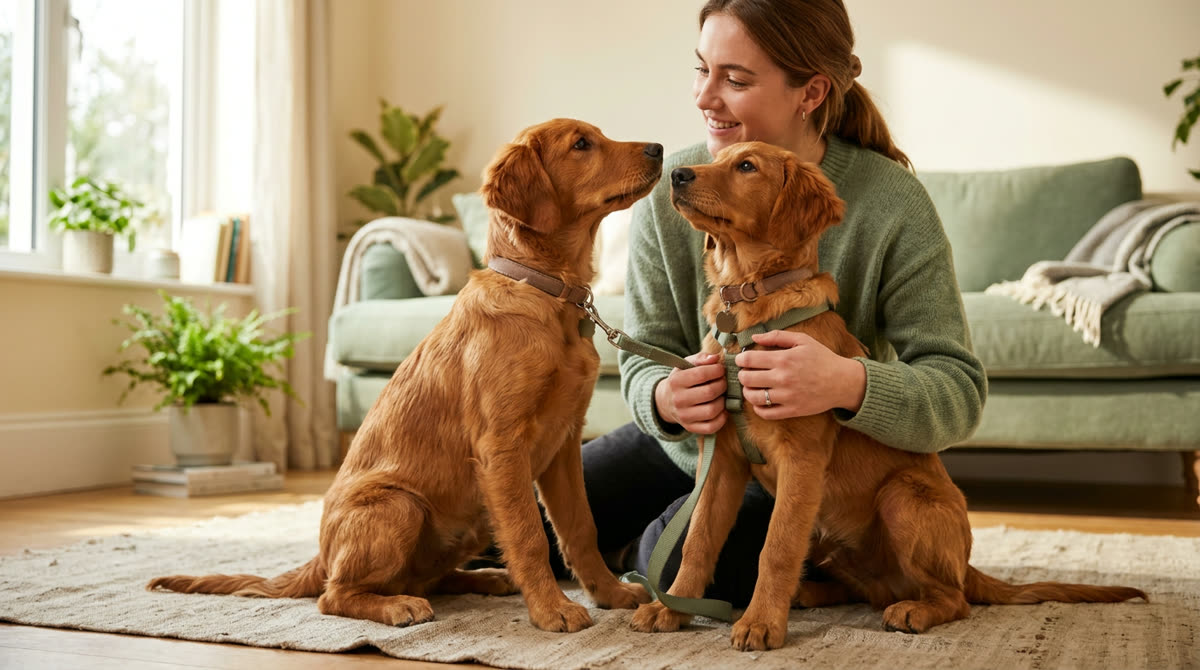
Choose a well-fitted, non-tightening harness, a fixed-length leash approximately 4–6 feet long, and a treat pouch you can reach without fumbling. A front-attachment harness can make some strong pullers easier to manage, but check that it does not rotate substantially, rub behind the elbows, or restrict the dog’s normal stride. Follow the manufacturer’s fit instructions, using room for roughly two flat fingers under straps as an initial check rather than proof that every harness fits securely. Before going outside, let your dog walk and turn indoors, then check that the harness cannot slip over the head or allow an elbow to slide through an opening. Avoid choke chains, prong collars, shock collars, and leash jerks, which can cause pain or distress without teaching your dog what to do instead. Keep the leash out from under the legs, never wrap it around your fingers or wrist, and do not use a retractable leash for these early sessions because changing distance makes consistent feedback harder.
- Check buckles, stitching, clips, and leash wear.
- Confirm straps do not pinch the armpits.
- Keep identification tags and microchip details current.
- Carry waste bags, rewards, and water as needed.
Good to know: If your dog can pull you off balance, do not rely on equipment alone; arrange individual help from a qualified reward-based trainer before practicing near traffic.
- 3
Prepare Rewards and Teach a Marker
Prepare 30–50 soft, pea-sized or smaller treats that your dog can swallow quickly, using part of their regular food allowance when it is motivating enough. Keep treats to no more than about 10% of daily calories unless your veterinarian recommends another feeding plan, and make each piece especially tiny for small dogs. In a quiet room, say a short marker word such as “yes,” immediately give a treat, and repeat 10 times so the word begins to predict a reward. Next, with the harness and leash attached, mark and reward voluntary glances toward you or moments when your dog stands near you with slack in the leash. Deliver the food close to the outside seam of your trousers on the side you want your dog to use, because rewarding in a consistent location encourages them to return there. Practice for two or three minutes, then take a break; avoid repeatedly calling your dog’s name or holding food in front of their nose throughout the exercise, which can create dependence on a visible lure.
- Choose one marker word or use a clicker.
- Use quick-to-eat, dog-safe rewards.
- Pick one walking side for early practice.
- Keep treats concealed until after marking.
Good to know: For dogs on prescription diets or with food sensitivities, ask your veterinarian which training rewards fit their dietary needs.
- 4
Build Loose-Leash Steps Indoors
Start in a hallway, living room, or securely enclosed yard, where your dog can learn the movement pattern without competing traffic, wildlife, or unfamiliar dogs. Stand with a small J-shaped curve in the leash, take one step, and mark and reward if your dog moves with you without tightening it. Repeat five times, then try two or three steps between rewards, keeping your pace comfortable enough that your dog does not have to trot or lag behind. When your dog succeeds on roughly four out of five attempts, increase the distance by one or two steps rather than jumping straight to an entire lap of the room. Add gentle turns by saying “this way” before moving, then reward your dog for following voluntarily instead of using the leash to steer their body. Keep each session to three to five minutes and finish with an easy success, returning to fewer steps if your dog surges ahead, crosses repeatedly, or loses interest.
Good to know: Hold the leash with enough slack for natural movement but not so much that it drags around your dog’s feet; constant tension makes a loose leash impossible to recognize.
- 5
Make Slack Leash the Way Forward
Move to a quiet outdoor stretch and initially reward every one to three loose-leash steps, because an easy indoor skill becomes harder when smells and movement appear. Watch for your dog accelerating and encourage a check-in before the leash tightens, marking and rewarding while there is still slack. If the leash does become taut in a safe location, stop your feet without jerking backward, hold your position calmly, and allow a brief pause for your dog to turn toward you or ease back. The moment the leash relaxes, acknowledge that choice and resume walking; give most food rewards during sustained loose-leash movement rather than creating a repeated pull-stop-treat routine. If your dog keeps leaning forward or cannot disengage, say your practiced turn cue and invite them toward a quieter direction without dragging them, then restart with an easier one-step reward. Apply the same rule consistently whenever it is safe, because letting pulling reach the next tree on some occasions can keep the habit strong even when other attempts are unsuccessful.
- Reward slack before pulling starts.
- Stop calmly when safe if tension appears.
- Resume movement as soon as slack returns.
- Make the next repetition easier after difficulty.
Good to know: Never stop to train in a road crossing or another hazardous spot; prioritize getting to safety, then reset where you have room.
- 6
Use Sniffing and Access as Rewards
Teach your dog that loose-leash walking unlocks the things they want, including a favorite patch of grass, a safe sniffing spot, or progress along the route. Approach an ordinary, low-distraction smell from a few feet away, ask for only one or two relaxed steps, and say “go sniff” as you move together toward it. Allow approximately 20–30 seconds of sniffing when the location is safe, then use a cheerful “let’s go” cue and reward your dog for leaving with you. If your dog drags toward the smell, pause or create a little more distance and try an easier approach rather than hauling them away or letting tight-leash pulling finish the trip. Alternate short stretches of structured practice with sniff breaks, since requiring an entire walk of close-position walking ignores an important part of a dog’s outdoor experience. Do not use greetings with unfamiliar dogs, chasing wildlife, or approaching reluctant people as rewards, because those situations are unpredictable and can reinforce unsafe rushing.
Good to know: Loose-leash walking is not the same as a formal heel: your dog can explore within the available leash length as long as the leash stays relaxed.
- 7
Increase Distractions Without Overwhelming Your Dog
Progress from indoors to a quiet outdoor area, then to a calm sidewalk, changing only one difficulty at a time: location, session length, or distraction level. Around a known trigger, begin far enough away that your dog can notice it while still moving comfortably, responding to you, and taking a reward; for some dogs this may mean 50 feet or more. Mark a voluntary glance back at you, reward beside your leg, and continue along a curved route or behind a visual barrier instead of marching directly toward the distraction. If your dog becomes rigid, stares persistently, refuses normally appealing food, barks, or lunges, increase distance promptly rather than asking for repeated sits while the trigger gets closer. Practice an emergency U-turn separately in a quiet place by saying “this way,” turning 180 degrees, and rewarding several steps with you, so it is familiar before you need it. If reactions are frequent, intense, involve snapping, or make handling unsafe, seek a qualified reward-based trainer and discuss the behavior with your veterinarian, who can advise whether a veterinary behaviorist is appropriate.
- Start with one mild distraction at a distance.
- Keep escape routes and visual barriers available.
- Avoid on-leash greetings during early practice.
- End exposure before frustration escalates.
Good to know: Treat refusal is useful feedback but not a diagnosis; heat, discomfort, fullness, and stress can all affect appetite, so assess the whole situation.
- 8
Troubleshoot Plateaus and Difficult Starts
If your dog explodes out of the doorway, practice the departure separately: clip on the leash, reward a relaxed pause, open the door a few inches, and continue only when you can exit together safely. If stopping repeatedly makes your dog frustrated or causes leash biting, shorten the session, reward more frequently before tension develops, and switch to gentle direction changes with your practiced cue rather than engaging in tugging. When pulling begins only later in the walk, consider whether the route is too stimulating, the session is too long, or your dog needs water or rest, then shorten the next outing accordingly. For an energetic dog, try five minutes of easy food-search games or comfortable free movement in a secure space before practice, without using exhausting exercise as a substitute for teaching. Separate necessary toilet outings from focused three-to-five-minute lessons by choosing the quietest available route and keeping expectations simple, while still avoiding rewarding pulling whenever safely possible. If coughing, gagging, lameness, sore skin, or unusual exercise intolerance occurs, stop and contact your veterinarian; breathing difficulty, collapse, or suspected heatstroke requires urgent veterinary care.
- Make doorway practice a separate mini-session.
- Lower difficulty after repeated unsuccessful attempts.
- Check harness contact points for rubbing.
- Avoid forcing a tired or frightened dog onward.
Good to know: Do not withhold bathroom access until your dog performs perfectly; meet their physical needs first, then practice where learning is realistic.
- 9
Maintain Progress and Review Your Plan
Aim for one or two focused three-to-five-minute sessions daily, fitted around age-appropriate exercise, toilet breaks, sniffing opportunities, and rest rather than replacing all walks with drills. After each outing, check paws and harness contact areas, offer water, and note one useful measure such as the number of loose-leash steps between rewards or pulling episodes along the same short route. Once your dog succeeds on roughly four out of five attempts across several sessions, vary rewards from every few steps to occasional longer stretches, while continuing to pay generously for difficult distractions and spontaneous check-ins. Use forward movement and sniffing alongside food rewards, and temporarily return to frequent treats after a change of location, a stressful event, or a break from training. Agree on the same marker, turn cue, and response to leash tension with every regular walker, because inconsistent rules can slow progress more than a short daily practice schedule. Review your notes weekly, expect improvement to develop over weeks rather than a guaranteed number of walks, and seek individualized professional help if two to four weeks of consistent, appropriately easy practice produces little improvement—or sooner if safety is a concern.
- Track progress on a repeatable, quiet route.
- Share the training plan with every walker.
- Keep rewarding particularly good choices.
- Refresh easier exercises when pulling returns.
Good to know: Progress means fewer and shorter pulling episodes as well as longer stretches of slack leash; one difficult walk does not erase what your dog has learned.
Ask about this guide
Leave a comment or a question about your own pet and the Pawlito assistant replies right away with practical next steps.