How to Stop a Puppy From Biting Hands and Ankles
Stop puppy biting with gentle, practical training that protects hands and ankles, builds calm habits, and explains when to seek help.
A calm, safety-first approachThis guide provides general education. Contact your veterinarian when symptoms are painful, persistent, or unusual.
- 1
Prepare a safe setup before the next bite
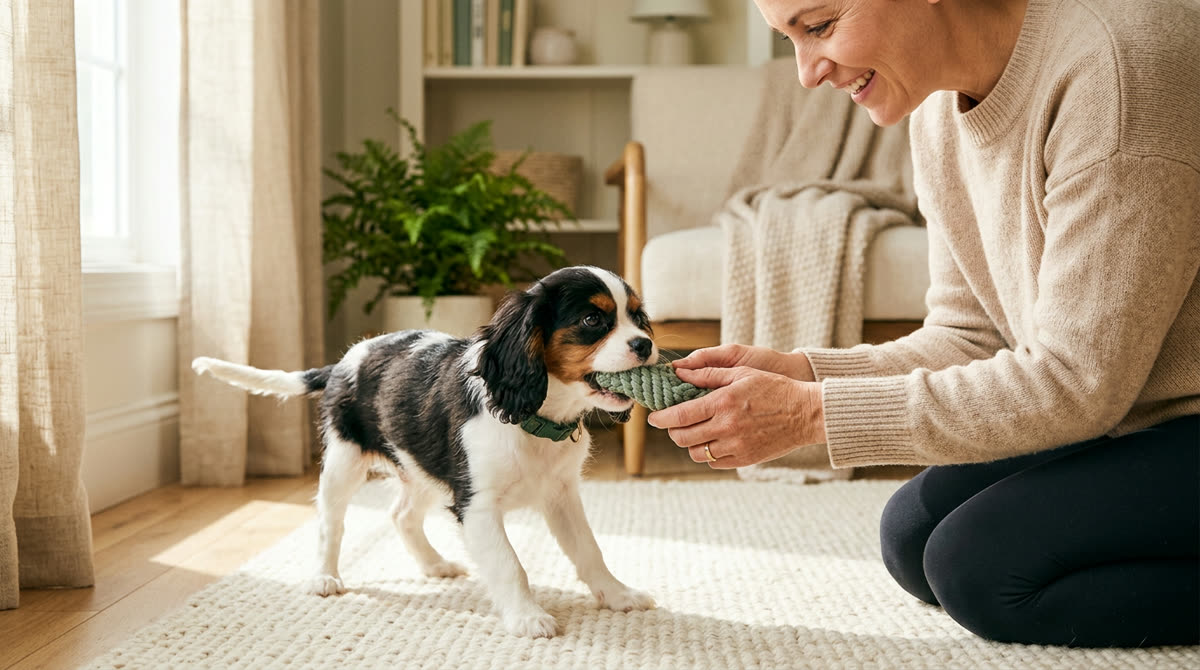
To stop a puppy from biting hands and ankles, start by changing the setup rather than waiting until teeth touch skin to react. Place a baby gate or exercise pen near your main living area so you can create a brief, safe separation without grabbing the puppy’s collar. Keep two or three puppy-safe toys within reach, including a soft tug toy approximately 12–18 inches long that puts comfortable distance between your fingers and your puppy’s mouth. Choose toys appropriate for your puppy’s size, inspect them daily, and remove anything with loose threads, broken pieces, or stuffing the puppy can swallow. Wear closed-toe shoes and fitted trousers during the training period, because swinging hems, slippers, and dangling laces can encourage ankle chasing. Put away hand-wrestling games and ask everyone in the household to use the same response: pause, offer an appropriate activity when the puppy can engage safely, and briefly disengage if biting continues. These preparations reduce opportunities to rehearse biting and make your response predictable instead of turning every incident into an exciting chase.
- Install a gate or puppy pen in a familiar room.
- Keep long, soft toys in several accessible locations.
- Remove dangling clothing and loose shoelaces.
- Agree on one consistent household response.
Good to know: Never muzzle, tie up, or hold a puppy’s mouth closed to manage normal mouthing; these approaches can cause distress and do not teach an alternative.
- 2
Identify what happens before the biting
For the first three days, note when puppy biting occurs, what happened immediately beforehand, and what your puppy did afterward. Common patterns include grabbing hands during petting, chasing ankles when someone walks away, and biting more intensely after a long play session or near bedtime. Loose, bouncy movements often accompany play, but they do not make painful biting something you must tolerate. Teething may increase the urge to chew, particularly around 3–6 months of age, although replacing baby teeth does not explain every biting episode. Watch for early signs that your puppy needs a change of activity, such as repeatedly missing the toy, jumping toward sleeves, or becoming unable to respond to a familiar cue. If touching one area reliably triggers biting, or your puppy freezes, stiffens, guards an item, or tries to escape handling, stop that interaction rather than testing the reaction again. The goal is to identify useful patterns without labeling your puppy as dominant, stubborn, or aggressive based on a few incidents.
- Record the time and activity before each episode.
- Note recent sleep, meals, and toilet breaks.
- Distinguish moving-ankle chasing from handling-related biting.
- Write down what helped the puppy settle.
Good to know: Contact your veterinarian if biting starts suddenly, changes markedly, or accompanies touch sensitivity, limping, reduced appetite, or other signs of discomfort.
- 3
Balance sleep, chewing, and age-appropriate activity
Build a flexible daily rhythm of toilet breaks, meals, short activities, chewing opportunities, and quiet rest, because an overtired puppy often becomes harder to redirect. Many young puppies sleep roughly 18–20 hours in a 24-hour period, though individual needs vary and rest should never replace appropriate social contact or enrichment. After an active period, offer a toilet break and then a comfortable, puppy-proofed resting area rather than adding more rough play to tire the puppy out. Break training into 2–3-minute sessions and provide gentle sniffing, exploration, and age-appropriate play instead of prolonged running or repetitive jumping. For chewing, offer a puppy-appropriate rubber chew or food toy sized so it cannot be swallowed, following the manufacturer’s age guidance and supervising initial use. A refrigerator-chilled puppy teething toy may soothe chewing urges, but avoid rocks, antlers, cooked bones, and very hard items that can injure teeth. If biting clusters in the evening, bring the quiet period forward by 15–30 minutes and see whether that adjustment reduces the next few evenings’ incidents.
- Provide a quiet, comfortable place to sleep.
- Use brief training and exploratory play sessions.
- Rotate two or three appropriate chew options.
- Schedule toilet breaks before settling for rest.
Good to know: Use a crate for rest only if your puppy is comfortable with it and its needs have been met; never force a distressed puppy into one as punishment for biting.
- 4
Teach a replacement behavior while your puppy is calm
Before practicing around tempting hands or feet, teach your puppy that keeping four paws on the floor, sitting, or going to a mat makes good things happen. In a quiet room, say a short marker word such as “yes” the instant your puppy offers the chosen behavior, then place a small treat on the floor so your fingers are not the target. Use part of the daily food allowance where practical, and keep extra treats within about 10% of daily calories unless your veterinarian recommends otherwise. Practice for 1–2 minutes at a time, three to five times daily, stopping while your puppy is still engaged. Separately, introduce “get your toy” by saying the phrase as your puppy takes an offered toy, then reward that choice with a few seconds of gentle play. Gradually practice the same behaviors before ordinary trigger moments, such as standing up from the sofa or walking toward the kitchen. Teaching these skills when your puppy can think clearly is much more effective than repeatedly asking for a sit in the middle of frantic ankle biting.
Good to know: If treat delivery itself causes finger grabbing, place rewards on the floor or in a small dish rather than holding them between your fingertips.
- 5
Respond to hand biting calmly and consistently
When teeth touch your hand during play, stop moving it as much as safely possible and avoid jerking away, which can make your hand behave like a fleeing toy. Wait for the puppy to release rather than prying the mouth open, then place your hands out of reach and pause the interaction. If your puppy is still loose-bodied and able to engage, present a long toy at mouth level and move it gently away from your body so chewing has an appropriate target. Resume calm play when your puppy chooses the toy, but if teeth immediately return to skin or clothing, step behind a nearby gate for a 10–20-second break. Return quietly and offer a simpler activity; after two or three unsuccessful restarts, stop the game and check whether the puppy needs a toilet break, food at its usual mealtime, or sleep. Avoid shouting, squealing, nose tapping, scruff shaking, and holding the muzzle shut, since these can increase excitement or make hands feel threatening. Between incidents, prevent the pattern by presenting toys before play begins and, during petting, stroking the shoulder or chest for 1–2 seconds before pausing to see whether your puppy wants more contact.
- Stop hand movement without wrestling.
- Offer a long toy when redirection is safe.
- Briefly step away if skin biting resumes.
- End repeated failed restarts and reassess needs.
Good to know: A loud “ouch” helps some puppies pause but excites others; a quiet, predictable stop is often more useful than trying to imitate another puppy’s yelp.
- 6
Practice walking past without ankle chasing
Treat ankle biting as a moving-target problem: before walking through a known trouble spot, ask your puppy to get a toy or place a few pieces of kibble in a safe spot away from your route. For planned practice, begin with your puppy calm and stand still nearby, marking and rewarding attention to you or four paws on the floor without teeth on clothing. Take one slow step, then mark and reward beside or slightly behind the puppy before it launches at your ankle. Build from one step to three, then five, increasing speed and distance separately only when your puppy succeeds at the easier level. If the puppy grabs a trouser leg, stop walking rather than kicking, dragging it along, or pulling the fabric into a tug game, and redirect to a long toy once you can do so safely. If you cannot move safely, use a toy or a small food scatter away from your feet to create space and reach a gate, but make the next session easier so biting does not become the regular way to start a reward sequence. Aim for two or three successful passes in a 1–2-minute session, because frequent easy practice teaches self-control more effectively than one long session of chasing and corrections.
- Start with a calm puppy and one slow step.
- Reward before teeth reach shoes or trousers.
- Increase movement difficulty gradually.
- Use gates during busy household transitions.
Good to know: Do not use a leash to jerk the puppy away from ankles or leave it tethered unattended; barriers are usually a safer household management tool.
- 7
Protect children and make greetings easier
Young children’s quick movements, high voices, and low-hanging hands can make puppy biting more likely, so an adult should actively supervise every interaction. Use a gate or pen whenever the adult cannot stay close and attentive, including during cooking, school departures, and busy visits. Teach children to keep hands close to their body and stand still if the puppy approaches, but do not expect a frightened child to manage a biting puppy without immediate adult help. Arrange short, calm activities such as an adult-led sit-and-reward game, with the child placing or tossing food away from their body rather than running with a toy. For visitors, let the puppy observe from behind a barrier first and begin contact only when it can keep its feet on the floor and take part without grabbing. Keep initial greetings to about 30–60 seconds, then offer a quiet break before excitement builds. Never require the puppy to accept hugging, face-to-face contact, or repeated head pats, because restricting movement and ignoring attempts to leave can turn an avoidable interaction into a bite.
- Separate puppy and children without active supervision.
- Keep running games away from the puppy.
- Let the puppy move away from contact.
- Make visitor greetings brief and structured.
Good to know: If a bite breaks a person’s skin, wash it promptly with soap and running water and seek medical advice, especially for hand wounds, deep punctures, or any bite to a child.
- 8
Troubleshoot repeated or escalating biting
If your puppy keeps biting despite redirection, review whether the toy appears too late, the play is too intense, or someone still rewards grabbing with chasing, pushing, or hand-wrestling. Move toy presentation earlier, shorten the activity by a minute or two, and practice easier replacement behaviors in a quieter room. If brief separation causes frantic barking, repeated jumping at the barrier, or distress, do not keep extending the break; instead, reduce stimulation and use a familiar safe area with appropriate company and a settling activity. Avoid repeatedly waving a toy at a puppy that is biting harder, because that usually signals that the current interaction needs to end rather than become more exciting. Contact your veterinarian promptly for sudden or worsening biting, pain-related reactions, broken teeth, mouth bleeding beyond minor teething spotting, or other changes in health or behavior. Repeated puncture bites, stiff or threatening responses around possessions, or biting during necessary handling also warrant professional assessment rather than more provocative home testing. Ask your veterinarian about a reward-based trainer experienced with puppies or a veterinary behaviorist, and avoid anyone recommending intimidation, physical corrections, or methods based on establishing dominance.
- Check for mixed responses from family members.
- Reduce session length and environmental excitement.
- Stop interactions that are becoming more intense.
- Seek help early for injury, guarding, or handling concerns.
Good to know: Never take away a guarded object just to prove you can; keep people away and arrange professional guidance, using a safe trade only if you can do so without risk.
- 9
Track progress and maintain the habit
Review your notes once a week and look for fewer biting episodes, lighter pressure, faster recovery, and more spontaneous choices to pick up a toy or settle. Set a practical first goal, such as completing three calm room crossings or one short play session without teeth touching skin, rather than expecting an immediate bite-free day. Keep the same response for at least 1–2 weeks while adjusting sleep, activity, and difficulty, but do not delay veterinary or behavioral help when safety concerns are present. As your puppy succeeds, reward some easy repetitions with praise or access to a toy while continuing food rewards for harder situations, such as visitors arriving or people walking quickly. Maintain gates and supervision until success is reliable, because removing every management tool after one good afternoon can bring ankle chasing straight back. Many puppies mouth less as they mature and finish teething, often around six months, but age alone does not teach them how to interact safely with hands and feet. If there is no clear improvement after 1–2 weeks of consistent practice, arrange a veterinary check and qualified training support so the plan can be tailored to your puppy and household.
Good to know: Measure progress against your puppy’s own starting point, not another puppy’s timeline; small, repeatable improvements matter more than one unusually calm day.
Ask about this guide
Leave a comment or a question about your own pet and the Pawlito assistant replies right away with practical next steps.