How to Switch Your Dog to New Food Without Upsetting Their Stomach
Make switching dog food easier with a gradual feeding schedule, accurate portions, and clear advice on stomach symptoms and when to call your vet.
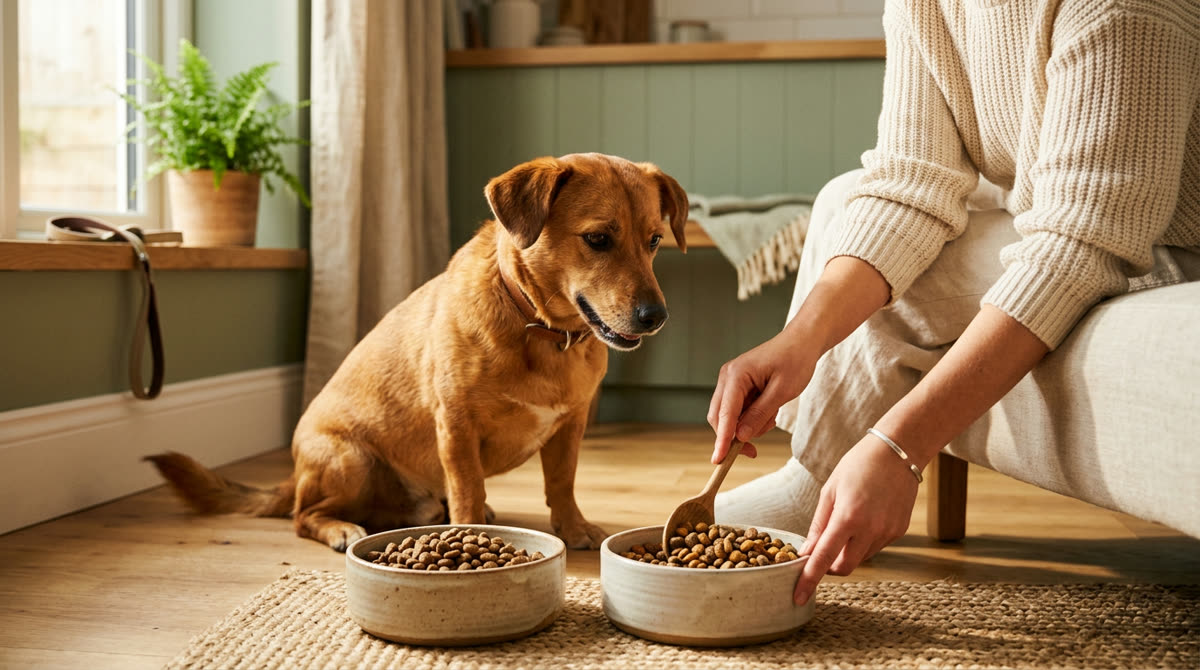
A calm, safety-first approachThis guide provides general education. Contact your veterinarian when symptoms are painful, persistent, or unusual.
- 1
Choose the right time to make the switch
For most healthy dogs, switching dog food works best over 7–10 days, although dogs with a history of digestive sensitivity may need 10–14 days or a veterinarian-directed schedule. Choose a relatively quiet week rather than starting just before boarding, travel, or a major household change, because stress can affect appetite and stool quality. If possible, keep enough of the current food for the full transition, plus another 2–3 days in case you need to slow down. Before starting, contact your veterinarian if your dog already has vomiting, diarrhea, unexplained weight loss, or a persistent change in appetite; changing food is not a substitute for evaluating those signs. Get individualized guidance first for very young puppies, pregnant or nursing dogs, and dogs eating a therapeutic diet or receiving treatment for an ongoing health problem. Write down why you are changing foods, such as moving to an adult formula, addressing availability, or following a veterinary recommendation, so you can judge whether the switch achieves its purpose. If the old food has been recalled or appears spoiled, do not continue feeding it just to maintain a gradual transition; ask your veterinarian how to move safely to a replacement.
- Pick a low-stress 7–10-day window.
- Check your supply of the current food.
- Confirm that your dog is eating and behaving normally.
- Ask for veterinary guidance when health issues are involved.
Good to know: Do not begin a food transition and several new supplements at the same time; if digestive trouble develops, you will not know which change contributed.
- 2
Select a nutritionally appropriate replacement
Choose a dog food labeled complete and balanced for your dog's life stage, rather than a topper, mixer, or product intended only for intermittent or supplemental feeding. In the United States, look for an AAFCO nutritional adequacy statement; elsewhere, check for the corresponding complete-food labeling and recognized nutritional standards. Puppies need a growth-appropriate diet, and large-breed puppies need a formula whose adequacy statement specifically covers growth of large-size dogs. For a routine brand change, a food with a similar format and broadly similar nutritional profile may make the adjustment less dramatic than switching several features at once. However, matching the protein source does not guarantee tolerance, and words such as “natural,” “premium,” or “sensitive” do not establish that a food is right for your dog. Check the manufacturer's calorie information, feeding guidance, contact details, and quality-control information, and buy a small bag or a few cans before committing to a large purchase. If the switch is part of a veterinarian-supervised elimination diet or therapeutic plan, follow that exact plan because mixing in the old food, treats, or flavored extras may interfere with its purpose.
- Complete and balanced for the correct life stage
- Appropriate growth statement for large-breed puppies
- Clearly stated calories per cup, can, or kilogram
- Intact packaging and an acceptable best-before date
Good to know: A grain-free label is not a shortcut to an easier transition or a gentler diet; ask your veterinarian which formulation fits your dog's needs.
- 3
Calculate portions before mixing the foods
Find the calorie density of both foods before choosing portions, because equal scoops can supply very different amounts of energy and accidental overfeeding can contribute to loose stools. If your dog maintains a healthy weight on the current intake, use that daily calorie amount as a starting reference; otherwise, ask your veterinarian for an appropriate target rather than assuming the package chart is exact. For foods labeled in kilocalories per kilogram, divide that number by 1,000 to find kilocalories per gram, then use a digital kitchen scale to weigh each portion. As an illustration only, a dog receiving 600 calories daily would eat 200 grams of an old food containing 3 calories per gram, but only 150 grams of a new food containing 4 calories per gram. At a 75% old-food and 25% new-food stage, that example becomes 150 grams of old food plus 37.5 grams of new food across the entire day, not those amounts at every meal. Calculate the transition percentages by calories whenever practical, especially when changing between dry and wet foods, because volume and moisture content can differ substantially. Keep treats within the existing daily calorie allowance, generally no more than 10% of total calories, and avoid adding food on top of the measured ration to encourage acceptance.
- Record each food's calorie density.
- Establish the total daily calorie allowance.
- Weigh the old and new portions separately.
- Divide the daily ration among scheduled meals.
Good to know: If the label lists only calories per cup or can, calculate each food's share using that information or ask the manufacturer for calories per gram.
- 4
Set up a consistent feeding routine
For 2–3 days before the transition, note your dog's usual appetite, stool consistency, bowel-movement frequency, and energy level so you have a meaningful baseline. Keep feeding times stable, with the daily ration divided into two meals for many healthy adult dogs; puppies commonly need three or four meals, depending on age and veterinary advice. Use clean bowls and a quiet feeding spot, and feed dogs separately if competition causes gulping or prevents you from knowing who ate which portion. Keep fresh water available at all times, particularly when moving from wet food to dry food, since the new diet supplies less water through meals. Pause new chews, table scraps, rich training treats, and other optional additions throughout the transition, while keeping any established veterinarian-directed care unchanged unless advised otherwise. Store dry food in its original bag inside a clean, sealed container, and refrigerate opened wet food promptly according to the label rather than leaving a mixed meal out all day. Start a simple phone note with columns for the food ratio, grams fed, appetite, stool, and any vomiting, because a short daily record makes patterns much easier to identify.
- Record a 2–3-day digestive baseline.
- Maintain regular meal times.
- Provide unrestricted access to fresh water.
- Remove unrelated dietary changes.
- Track portions and symptoms daily.
- 5
Introduce a small amount of new food
On days 1 and 2, offer approximately 75% of your dog's daily food calories from the old diet and 25% from the new diet, unless your veterinarian recommends another starting point. Mix those proportions into every scheduled meal rather than serving one entirely old-food meal followed by one entirely new-food meal, which creates a larger change at a single sitting. For a dog with a known history of difficulty tolerating food changes, begin with about 10% new food and plan a longer transition instead of assuming the standard schedule will fit. Blend the foods thoroughly enough to reduce picking around the unfamiliar pieces, using the premeasured portions rather than estimating by appearance. If your dog is reluctant, try adding a small splash of warm water immediately before serving to enhance aroma, but avoid hot water and discard uneaten moistened food promptly. Keep the overall calorie intake steady, and do not add fatty broth, cheese, or meat drippings, which introduce extra ingredients and can create digestive problems of their own. Stay at this starting ratio until your dog has eaten comfortably and passed stools close to their usual consistency for roughly 48 hours.
Good to know: If your dog consistently picks out only the old food, do not rush ahead or try to force acceptance through prolonged hunger; discuss an alternative food or approach with your veterinarian.
- 6
Increase the new food in measured stages
For a healthy dog tolerating the first stage, move to 50% old food and 50% new food on days 3 and 4, then 25% old food and 75% new food on days 5 and 6. Offer 100% new food on day 7 only if appetite, comfort, and stool quality have remained normal; holding the middle stages longer naturally extends the process to 8–10 days. Treat this schedule as a guide rather than a deadline, since there is no benefit to finishing quickly if your dog is struggling with the change. For a slower 10–14-day transition, start at 10% new food and increase its calorie share by roughly 10–20 percentage points every 2–3 days as tolerated, extending the timeline if necessary. Recalculate or preweigh portions for each stage, particularly if the new food is more calorie-dense, so the shrinking scoop size does not tempt you to top up the bowl. Keep the same ratio across meals and ask other household members to follow the written plan rather than giving an extra scoop or using up the old food unpredictably. If symptoms appear after an increase, stop advancing the schedule and assess their severity before making another change.
- Days 1–2: 75% old food, 25% new food
- Days 3–4: 50% old food, 50% new food
- Days 5–6: 25% old food, 75% new food
- Day 7 onward: 100% new food if well tolerated
Good to know: These percentages represent shares of food calories, not necessarily equal cup or spoon measurements; use the portion calculations from the preparation stage.
- 7
Check digestion and appetite every day
Check each bowel movement during the transition, looking for formed stools that are easy to pick up rather than requiring an exact match in color or size to stools produced by the old food. A different formula can change stool volume or frequency, but repeated watery stools, obvious straining, or mucus accompanied by other symptoms should not be dismissed as routine adjustment. Record appetite at every meal, noting whether your dog finishes normally, eats much more slowly, picks through the mixture, or refuses food altogether. Also watch for new gas, lip licking, drooling, restlessness, a hunched posture, or reluctance to move, because stool alone does not show whether your dog feels comfortable. Track water intake approximately by noting refills and unusual drinking behavior, but never restrict water to try to control diarrhea. In a healthy adult dog, one slightly softer stool with otherwise normal behavior may justify holding the current ratio for another 24–48 hours rather than immediately changing foods again. If signs recur, worsen, or come with reduced appetite or energy, contact your veterinarian instead of continuing to increase the new food.
Good to know: Take a stool photo and save the food labels and batch codes if a problem develops; those details, together with your feeding log, can help your veterinarian assess the situation.
- 8
Slow down or seek help when problems arise
If a healthy adult dog develops only mildly soft stool after an increase and is otherwise bright, comfortable, and eating, pause the transition or return to the last well-tolerated ratio for 24–48 hours, provided the old food remains safe and medically appropriate. Contact your veterinarian if mild diarrhea persists beyond 24 hours, recurs when you retry an increase, or is accompanied by vomiting, reduced drinking, or changes in behavior. Seek prompt advice sooner for puppies, frail seniors, very small dogs, or dogs with existing illnesses, since they may be less able to tolerate fluid loss or missed meals. Stop the transition and seek urgent veterinary care for repeated vomiting, inability to keep water down, bloody or black tarry stools, marked lethargy, collapse, or obvious abdominal pain; a swollen abdomen with unproductive retching is an emergency. If an adult dog refuses all food for about 24 hours, contact your veterinarian, and seek advice much sooner for a young puppy, a dog with diabetes, or any dog that also seems unwell. Do not withhold food for a prolonged period, substitute an extended chicken-and-rice diet, or give human antidiarrheal medicines, supplements, or probiotics unless your veterinarian directs you. When symptoms repeatedly return at the same stage, stop experimenting with additional brands and share the feeding log with your veterinarian, because timing alone cannot establish that the new food caused the problem.
- Pause increases for isolated mild stool softening.
- Call for persistent or recurring digestive symptoms.
- Seek urgent care for severe signs or inability to retain water.
- Avoid human medicines and unsupervised fasting.
Good to know: Dogs needing an immediate medically directed diet change may require a different plan; ask the treating veterinarian before returning to the previous food.
- 9
Maintain the new diet and review the results
Once your dog is eating 100% new food comfortably, keep meals, portions, and extras consistent for another 1–2 weeks rather than immediately introducing several new treats. Continue the daily digestive log for at least 7 days after the final switch, since a few successful meals do not show how the full diet will work over time. Weigh your dog near the start and again after 2–4 weeks using the same scale when possible, and monitor body shape as well as the number because coat and size can obscure gradual weight changes. You should generally be able to feel the ribs under a light fat covering and see a waist from above, although your veterinarian can help assess body condition accurately. If weight trends upward or downward unexpectedly, review measured portions, treats, and activity with your veterinarian rather than relying solely on the new package's feeding chart. Keep the packaging and batch information until the food is finished, and store the remaining old food safely only if it is still usable and there is a reason to retain it. Consider switching dog food complete when your dog consistently eats the new diet, maintains comfortable digestion and suitable weight, and meets the original goal of the change—not simply when the calendar reaches day 7.
- Keep the diet stable for another 1–2 weeks.
- Track digestion for at least 7 days on the full new diet.
- Recheck weight after 2–4 weeks.
- Review ongoing concerns with your veterinarian.
Good to know: Growing puppies need more frequent portion reviews than mature dogs because their calorie needs change as they develop; arrange a growth-monitoring plan with your veterinarian.

Ask about this guide
Leave a comment or a question about your own pet and the Pawlito assistant replies right away with practical next steps.