How to Tame and Handle Pet Rats Gently
Make taming pet rats a calm, rewarding routine with gentle handling techniques, trust-building games, and practical safety advice.
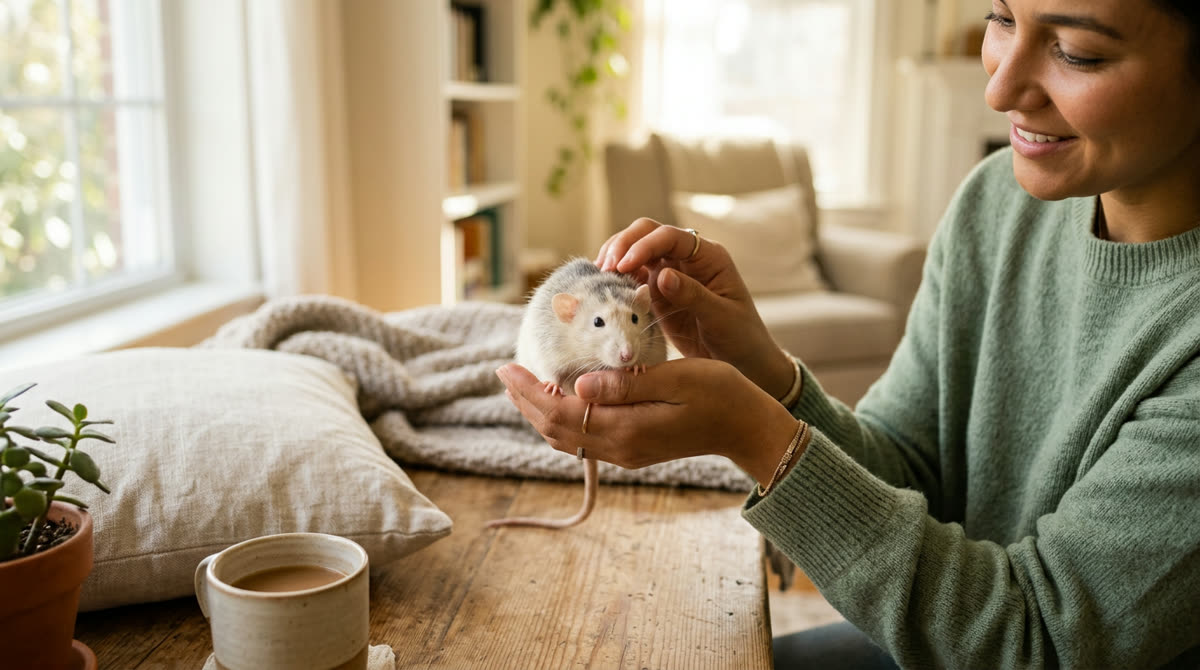
A calm, safety-first approachThis guide provides general education. Contact your veterinarian when symptoms are painful, persistent, or unusual.
- 1
Prepare a calm, rat-safe training space
Before you start taming pet rats, choose a quiet room where you can close the door, exclude other pets, and block access to electrical cords, reclining furniture, vents, and gaps behind appliances. Plan to work at floor level inside a secure play area rather than on a table or bed, because a startled rat can dart away or fall before you can react. Set out a ventilated, escape-proof carrier, a stable hide with a removable lid, a clean towel without loose threads, and several tiny food rewards so you will not need to interrupt a successful interaction. Use pea-sized pieces of a familiar rat-safe food, such as cucumber or cooked carrot, or a small oat flake, and keep treats a minor part of the diet rather than replacing balanced rat food. Wash your hands with an unscented product and rinse thoroughly, since food smells may encourage exploratory bites and strong fragrances can make an unfamiliar hand more intimidating. Keep bonded rats in compatible same-sex or appropriately neutered groups; separating a rat from its companions to make it depend on you is stressful and unnecessary. Finally, ask the breeder, rescue, or previous caregiver about each rat’s usual waking times, favorite rewards, and handling history, which will help you begin at a comfortable level.
- Close doors and remove other pets.
- Block escape gaps and protect electrical cords.
- Prepare a carrier, hide, towel, and tiny treats.
- Wash food smells from your hands.
- Keep compatible companions together.
Good to know: A rat-safe room still needs direct supervision. Do not use an exercise ball as a holding space or a shortcut to out-of-cage exercise.
- 2
Let your rats settle and learn their signals
Give newly arrived rats a predictable, low-pressure first 24–48 hours, providing food, water, and necessary spot-cleaning while avoiding repeated attempts to pick them up. This is a starting point rather than a deadline: a confident, previously handled rat may approach sooner, while a frightened rat may need considerably longer. Sit beside the cage for 10–15 minutes once or twice a day and speak softly so your voice becomes part of the ordinary environment without demanding an interaction. Approach when the rats are already awake, often in the evening, and announce yourself before opening the door instead of waking them by touching their sleeping nest. Look for voluntary exploration, sniffing, grooming, and accepting food with a loose body posture as useful signs that you can offer the next small challenge. Freezing, flattening against a surface, repeatedly retreating, puffed fur, or lunging mean you should increase distance and make the session easier rather than assuming the rat needs firmer handling. Take account of age, eyesight, and past experiences, and seek veterinary advice if an unusual reluctance to move or interact is accompanied by poor appetite, apparent pain, breathing changes, or a sudden behavior change.
- Work during a natural waking period.
- Speak before opening the cage.
- Reward voluntary approaches.
- Pause when the rat freezes or repeatedly retreats.
Good to know: Stillness is not always relaxation. A comfortable rat usually shows some normal curiosity or movement and has the option to leave.
- 3
Build trust with predictable food rewards
Start rat trust training with one- to three-minute sessions once or twice daily, ending while your rat is still comfortable rather than waiting for it to become overwhelmed. Open the cage door and place a tiny treat near the entrance, keeping your hand still and allowing the rat to collect the food and retreat. Over successive successful sessions, offer a treat from your fingertips at the doorway, or use a small spoon if the rat grabs food forcefully or you are worried about being bitten. Avoid pushing treats through the cage bars, because repeated feeding there can encourage snapping at fingers or anything else that appears between the bars. Pair the reward with a quiet, consistent word such as “good,” saying it as the rat approaches so the sound begins to predict something pleasant. If your rat will not eat, move farther away or leave the treat and end the session; refusal may reflect fear, being full, or simply a low-value reward, so never withhold its normal meals to force cooperation. When several rats crowd the doorway, spread out rewards or briefly work with one willing rat in an adjacent secure area without separating companions for long periods.
- Offer rewards through an open door, not the bars.
- Keep initial sessions to one to three minutes.
- Let the rat retreat after taking food.
- Use a spoon for enthusiastic grabbers.
- Never remove regular food to increase motivation.
Good to know: Avoid thick globs of peanut butter or other sticky pastes, which can be difficult to swallow. Tiny pieces of familiar food are easier to portion and offer safely.
- 4
Teach your rat to step onto your hand
Once your rat readily takes rewards near you, rest one hand palm-up on a stable surface at the cage entrance or inside the supervised play area, keeping the fingers relaxed and together. Place a treat near your fingertips first, then gradually position later rewards farther onto your palm so the rat chooses to put one paw, two paws, and eventually its body onto your hand. Keep your hand supported throughout this stage and do not suddenly lift it when the rat finally climbs aboard, because an unexpected loss of footing can undo several sessions of trust-building. Allow the rat to step off whenever it chooses, rewarding calm investigation instead of blocking the route back to its hide. Once stepping aboard is easy, say a short cue such as “up” just before presenting your palm, and use the same setup for several successful repetitions. If bare hands are too worrying, begin with a stable, short tunnel or a carrier placed on the ground, reward entry, and then gradually introduce your hand beside it. Progress according to behavior rather than a fixed calendar; some rats move through this stage within a few sessions, while others need weeks of patient repetition.
Good to know: Do not lure a rat across an unsupported gap to reach your hand. Give it a stable route so it can concentrate on learning rather than balancing.
- 5
Introduce touch before attempting a lift
When your rat remains relaxed beside or on your stationary hand, introduce a brief touch to the shoulder or side while it is standing securely, then reward calm acceptance. Begin with roughly one second of contact, using one or two fingers rather than reaching over the rat’s head with an open grasp. Bring your hand into view from the side and avoid approaching silently from directly above, which may startle a small prey animal even when it knows you well. Increase contact to two or three seconds only after the rat repeatedly stays comfortable, and remember that accepting food does not automatically mean it welcomes more touching. Next, practice sliding one hand gently beneath the chest just behind the front legs while the other hand stays close to support the hindquarters, without lifting yet. Keep fingers away from the throat, avoid pressing the abdomen, and never roll a reluctant rat onto its back or restrain it to make it “get used to” being touched. If it flinches, twists away, freezes, or repeatedly interrupts eating to monitor your hand, stop the contact and return to an easier approach-and-reward exercise.
Good to know: Some friendly rats enjoy climbing on people but dislike stroking or cuddling. Aim for comfortable, cooperative handling rather than requiring a particular style of affection.
- 6
Practice a fully supported, gentle lift
To pick up a pet rat gently, place one hand beneath the chest just behind the front legs and use the other to scoop and support the bottom and hind feet. Lift smoothly with the body held in a natural, roughly horizontal position, using enough support to prevent slipping without squeezing the chest or abdomen. For early practice, raise the rat only about 2–5 centimeters above a secure surface for one or two seconds, then lower it and offer a reward after all four feet are supported again. Repeat only a few times if the rat remains relaxed, gradually building toward a brief transfer onto your lap while you sit on the floor inside a secure area. Keep the rat close to your body and let its feet find support on your hands or forearms rather than allowing it to dangle or scramble up your clothing toward an unprotected shoulder. Never lift, drag, or restrain a rat by its tail, and do not scruff or pin it for routine handling, because these methods can cause injury, pain, and defensive reactions. If the rat wriggles hard, calmly lower it onto the nearest safe surface instead of tightening your grip or trying to finish the planned hold.
- Support both the chest and hindquarters.
- Keep the body close to a safe surface.
- Start with one- or two-second lifts.
- Lower the rat if it struggles.
- Never lift or restrain by the tail.
Good to know: A tail wound, exposed tissue, or suspected fall injury needs prompt veterinary attention. Stop handling practice and contact a veterinarian rather than trying another lift.
- 7
Move to short, supervised handling sessions
Once brief lifts are comfortable, begin with about five minutes of supervised interaction in a secure floor-level pen or rat-proof room, increasing the duration as your rats remain relaxed and engaged. Provide a familiar hide, tunnel, and access to the carrier so the space offers retreat options rather than leaving the rats exposed with only your hands nearby. Sit still and allow exploration of your lap and forearms, using tiny rewards for returning to you and avoiding repeated pickup-and-putdown cycles that interrupt every interesting investigation. Practice a useful return routine by saying “home,” placing a reward inside the carrier or accessible cage entrance, and letting each rat walk in before you close the door. Do not make the cue predict only the end of fun: occasionally reward entry and allow the rat back out, which helps preserve its willingness to return. Keep early sessions away from shoulders, high furniture, loose clothing that traps toes, and blankets with holes or frayed threads, and supervise children from within arm’s reach while they remain seated. These short sessions are handling practice, not a substitute for the longer daily opportunities for safe exercise, exploration, and social interaction that pet rats need.
- Start with roughly five minutes of handling practice.
- Include a familiar hide and carrier.
- Reward voluntary returns to your lap.
- Teach an easy carrier-entry routine.
- Keep children seated and closely supervised.
Good to know: For a rat that is not ready to be lifted, teach voluntary carrier entry first. Secure the door before moving the carrier; never carry a frightened rat in an open-ended tunnel.
- 8
Troubleshoot fear, grabbing, and biting
If progress stalls, change one variable at a time: shorten the session, work at a more suitable waking time, offer a familiar reward, or move your hands farther from a valued sleeping area. A rat that accepts treats outside its hide but objects to fingers inside it is showing you that the location matters, so invite it out rather than reaching into its refuge or dismantling the nest for routine practice. Light mouthing may occur during exploration, but do not encourage tooth contact with hand-wrestling games; pause, keep movements calm, and offer a suitable chew item after the interaction ends. If a bite occurs, avoid jerking upward, shouting, or striking the rat, and lower it to a secure surface if you were holding it before calmly ending the session. Wash any human bite promptly with soap and running water, and seek medical advice for punctures, hand wounds, persistent bleeding, infection signs, or concerns about tetanus or a weakened immune system. Seek prompt medical care if fever, rash, or joint pain develops after a rat bite or scratch, and tell the clinician about the rodent exposure. Stop training and contact a rat-experienced veterinarian for sudden or escalating aggression, pain when touched, reduced eating, lethargy, or breathing changes, because a health problem may be contributing and should not be treated as simple stubbornness.
Good to know: Open-mouth breathing, collapse, or severe breathing effort is an emergency. Stop handling, minimize stress, and contact an emergency veterinarian immediately.
- 9
Maintain trust and review progress
After each session, return your rat to its familiar enclosure or let it enter voluntarily, check that it is moving normally, and allow it to rest without immediately starting another interaction. Count training treats toward the day’s extras and maintain unrestricted access to fresh water and the usual balanced diet, rather than letting frequent rewards displace proper nutrition. Keep a simple log of the date, session length, highest comfortable handling stage, and any startle or bite triggers so you can judge progress across a week instead of comparing individual rats. Once handling is reliable, maintain it with brief, pleasant daily interactions and introduce other household members one at a time using the same cues and supported lifting method. Gradually practice useful care behaviors, such as entering a carrier, standing briefly on a low digital scale, and tolerating a quick visual check of the feet and underside, stopping before the rat becomes distressed. Weigh each rat weekly on the same scale when practical, and contact a veterinarian about unexplained weight changes, new lumps, movement difficulties, or a lasting change in behavior rather than trying to diagnose the cause yourself. Successful taming of pet rats means increasing voluntary cooperation and reducing fear, so celebrate a shy rat calmly stepping into a carrier just as much as a confident companion choosing to settle on your lap.
Good to know: After illness, a frightening event, or a long break, restart one or two stages below the previous level. Familiar, easy successes usually rebuild confidence better than testing what the rat will tolerate.


Ask about this guide
Leave a comment or a question about your own pet and the Pawlito assistant replies right away with practical next steps.