How to Make Safe Foraging Toys for Birds at Home
Make DIY bird foraging toys with bird-safe materials, easy food puzzles, and practical tips for choosing the right challenge and avoiding hazards.
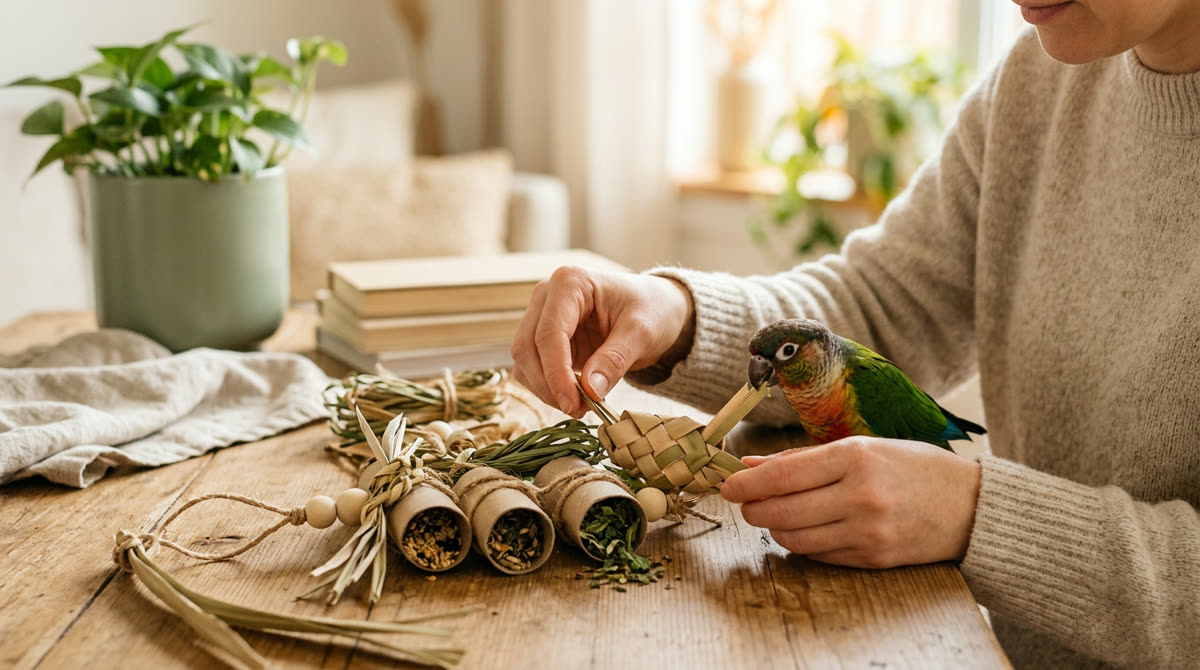
A calm, safety-first approachThis guide provides general education. Contact your veterinarian when symptoms are painful, persistent, or unusual.
- 1
Match the toy to your bird
Start making DIY bird foraging toys by watching how your bird eats, explores, and manipulates objects during two or three 5-minute observation sessions. A budgie that enjoys picking at paper needs a different challenge from a macaw that can tear through thin cardboard in seconds, while many finches and canaries do better searching an open tray than opening a packet. For a first project, choose a shallow search tray for a hesitant bird, a loosely folded paper packet for a confident shredder, or an edible leafy parcel for a bird that already enjoys vegetables. Size every component for the individual bird: avoid openings that could trap its head, beak, foot, or leg, and never assume a product labeled for birds fits every species. Birds with limited mobility or vision may need a stable, shallow dish beside an accessible perch rather than a toy they must climb to reach. Keep familiar food and water freely available throughout training, because foraging is enrichment rather than a test a bird must pass to eat. If your bird is currently ill, recovering from surgery, eating poorly, or on a specialized diet, ask an avian veterinarian which materials, foods, and activity levels are appropriate before starting.
- Observe whether your bird pecks, shreds, lifts, or searches.
- Choose a challenge it can investigate without climbing awkwardly.
- Check the size of every opening and removable part.
- Keep normal food and water accessible.
Good to know: No homemade bird toy is universally safe or indestructible. Supervise every new design, even if your bird has safely used similar materials before.
- 2
Gather simple, traceable materials
Prepare a clean work surface and gather scissors, a shallow stainless-steel bird dish, fresh plain unprinted paper, and a small piece of clean, uncoated cardboard from a known source. Paper sold for direct food contact is a useful choice, provided it is uncoated and free of printing, fragrances, and added treatments; skip waxed paper, parchment, and paper with a plastic lining. Choose cardboard without staples, tape, exposed adhesive seams, grease, or chemical odors, and avoid delivery boxes with unknown storage or contamination histories. Leave out toilet-paper rolls, egg cartons, and containers previously used for raw meat because their cleanliness, coatings, or adhesives can be difficult to verify. Do not assemble homemade foraging toys with glue, hot glue, tape, staples, wire, elastic bands, bells, beads, or string, since these introduce avoidable ingestion, puncture, or entanglement hazards. Also skip cotton rope, yarn, loose fabric, foam, brittle plastic, and unidentified wood, and remember that “natural” or “non-toxic for children” does not establish safety for a bird that chews and swallows pieces. Before building, run your fingers over every surface and edge, then discard anything with splinters, sharp corners, peeling layers, or an uncertain material composition.
- Use fresh, plain, uncoated paper.
- Select clean cardboard with a known history.
- Remove no fastener by simply hiding it inside the toy.
- Avoid cords, adhesives, loose fibers, and small hardware.
- Keep scissors and scraps away from your bird.
Good to know: Use cardboard only for birds that shred and drop it rather than swallow it. If you cannot verify a material, choose an edible puzzle or a washable dish instead.
- 3
Set aside suitable food rewards
Choose rewards your bird already recognizes, ideally reserving a small amount from its normal daily ration rather than adding a large serving of treats. For a bird that normally eats dry pellets, begin with three to five individual pellets distributed across the toy, adjusting the pieces to its usual food size. A small amount of a familiar seed or an appropriate unsalted nut fragment can provide extra motivation where the bird’s diet permits, but rich rewards should stay within its established treat allowance. For fresh-food puzzles, use washed, familiar vegetables such as a strip of bell pepper, a few carrot shreds, or a piece of romaine, cut to a size your bird already handles comfortably. Avoid avocado, chocolate, caffeine, alcohol, salty snack foods, fruit pits, and apple seeds, and do not use honey or nut butter as a sticky construction material. Keep wet produce separate from paper-and-cardboard projects, because moisture softens the structure and makes food residue harder to remove. Birds on nectar-based, medically managed, or other specialized diets need a species-appropriate reward plan, so check with an avian veterinarian rather than adapting a dry-seed puzzle by guesswork.
- Reserve rewards from the usual ration when practical.
- Use familiar foods in familiar bite sizes.
- Count rich treats toward the daily allowance.
- Keep fresh produce out of disposable dry-food puzzles.
Good to know: Never withhold meals to make a bird interested in foraging. A bird that is afraid of a new toy may also avoid nearby food, so keep a familiar feeding station elsewhere.
- 4
Fold an easy paper packet
For a beginner paper foraging toy, cut an approximately 10-by-10-centimeter square of suitable plain paper for a small parrot, or start with a roughly 15-by-15-centimeter square for a medium bird. These measurements are starting points rather than safety guarantees, so enlarge or simplify the design if your bird can swallow the packet, becomes tangled in torn pieces, or cannot manipulate it comfortably. Place one or two familiar dry-food pieces in the middle, bring two opposite edges toward the center, and make just one loose fold that leaves a reward partly visible. Set the packet in a stable shallow dish or on a washable play surface instead of suspending it with cord or attaching it with improvised hardware. During the first session, let your bird take the visible food without needing to rip anything, then demonstrate lifting the paper edge with your fingers if it remains uncertain. Once the bird succeeds comfortably in several sessions, tuck the edge slightly farther over the food, but avoid tight twists, multiple layers, and densely compressed paper balls. Remove the packet as soon as food is gone or the paper becomes wet, heavily fragmented, or contaminated, since the goal is a brief supervised search rather than unlimited access to deteriorating material.
- Start with one layer and one loose fold.
- Leave a reward visible for the first attempt.
- Place the packet on a stable surface.
- Increase concealment only after easy successes.
Good to know: Shredding paper is not the same as swallowing it. If you see deliberate ingestion or cannot tell where the missing material went, remove the toy and use a non-paper alternative.
- 5
Build a shallow search tray
Choose a shallow stainless-steel dish approximately 10–15 centimeters across for a small bird, or a larger stable dish that allows your bird to search without squeezing into it. Set it on a secure platform or flat play surface away from the cage bottom, where droppings and damp litter can quickly contaminate food. For the easiest version, scatter three to five pieces of the bird’s usual dry food across the empty dish so it learns that investigating the tray pays off. Next, partially cover two food pieces with two or three broad, flat paper squares, approximately 4–6 centimeters across for a small bird, leaving exposed food available as an obvious starting point. A bird that already shreds cardboard safely can try lifting one clean, uncoated cardboard square with smooth edges instead, but remove it when chewing produces loose layers or small fragments. Keep the covering layer shallow and sparse, and avoid shredded-paper bedding, long strips, deep filler, or pieces your bird can swallow whole. If your bird is a finch, canary, or another species unlikely to lift a cover, stay with visible food spread around the dish rather than adding a task that does not suit its feeding behavior.
- Use a stable, shallow, washable dish.
- Introduce visible food before adding covers.
- Keep some rewards uncovered.
- Avoid deep filler and narrow paper strips.
Good to know: Do not add sand, grit, soil, or litter to make the tray look more natural. These materials complicate hygiene and may be swallowed unnecessarily.
- 6
Make an edible leafy parcel
For a bird that already eats leafy vegetables, wash a fresh romaine leaf or another familiar, veterinarian-approved edible leaf under running water and shake off excess moisture. Trim a piece approximately 5–8 centimeters across for a small parrot, keeping the portion appropriate for the bird rather than offering a large bundle it cannot manage. Put a few familiar carrot shreds or a small piece of bell pepper near the middle, then loosely fold one side of the leaf over the filling without tying, pinning, or fastening it. Place the parcel in a shallow stainless-steel food dish, with some filling showing so the bird can recognize it as food rather than an unfamiliar object. On later attempts, fold a little more leaf over the reward, but keep the parcel loose enough to open with a gentle beak nudge. Make this a supervised 10–15-minute activity, discard the leftovers afterward, and do not leave fresh-food toys sitting out beyond 1–2 hours even in a cool room, removing them sooner in warmth. If your bird has never accepted vegetables, offer the leaf and filling separately first rather than making a new food and a new puzzle part of the same challenge.
Good to know: Edible puzzles avoid many construction hazards, but portions and ingredients still matter. Do not use unidentified garden leaves or plants exposed to pesticides.
- 7
Introduce the toy in short sessions
Offer the new foraging toy at a calm, familiar time, such as during the bird’s usual supervised play period, rather than immediately after a fright or a major cage change. For a cautious bird, start with the toy 30–60 centimeters outside its cage while you supervise, moving it farther away if the bird freezes, retreats, or becomes agitated. When the bird appears comfortable, place the toy on a familiar stable surface and demonstrate touching the cover or revealing a reward without pushing the object toward its face. Keep initial sessions around 3–5 minutes and end after one or two successful discoveries, because a short positive experience is more useful than a long struggle. Praise calm investigation in your usual voice, and let the bird choose whether to approach instead of placing its feet or beak on the toy. Change only one feature at a time—such as folding a flap slightly farther—after the bird solves the easier version readily in at least two or three sessions. Once it understands the activity, offer supervised 10–15-minute sessions as tolerated, checking throughout for slipping, caught toes, wet material, and pieces being swallowed.
Good to know: Some birds need days or weeks to accept a new object. Moving more slowly is safer than placing an unfamiliar toy beside the only food bowl and waiting for hunger to overcome fear.
- 8
Troubleshoot frustration and safety problems
If your bird ignores the toy, first make the reward more visible, move the activity to a familiar location, and use a food it already likes rather than adding more layers or stronger-smelling foods. If it tears the toy apart without eating, that may simply mean it prefers shredding, so offer the food in an open dish and assess whether paper-based foraging is useful for that individual. Repeated retreating, frantic flapping, freezing, or lunging when the toy approaches means the introduction is too intense; remove it and restart later at a greater distance. If your bird finds every reward immediately, add one loose flap or hide just one piece under a cover instead of using tight folds, heavy lids, or stronger materials that introduce new hazards. Stop the activity immediately for any caught toe or beak, deliberate swallowing of non-food material, bleeding, sudden weakness, or breathing difficulty, and do not pull against trapped tissue or force the beak open. Breathing difficulty, collapse, substantial bleeding, or an entrapment you cannot safely release requires urgent veterinary help, while suspected ingestion of toy material warrants prompt advice from an avian veterinarian even if the bird seems normal. Also contact your veterinarian promptly if eating decreases, droppings change markedly, or unusual lethargy follows play, and save a sample or photograph of the toy material to help explain the exposure.
- Ignored toy: expose the reward and simplify.
- Fearful behavior: remove the toy and increase distance.
- Instant success: add only one small challenge.
- Swallowed material or injury: stop and contact a veterinarian.
Good to know: Do not try to induce vomiting or give oil, medication, or a home remedy after suspected ingestion. Ask a veterinarian what to do next.
- 9
Clean, rotate, and review the routine
At the end of each session, remove all remaining food and discard used paper, cardboard, and leafy parcels rather than storing them for another day. Wash reusable dishes with hot water and a small amount of unscented dish detergent, rinse thoroughly, and let them dry completely before refilling. If disinfection is necessary, move the bird away and follow your avian veterinarian’s guidance and the product’s dilution, contact-time, and rinsing instructions; never mix cleaning products. Keep unused construction materials in a clean, dry container, and discard supplies that develop dampness, mold, pest contamination, or an unfamiliar odor. Rotate among two or three successful DIY bird foraging toys across the week, retaining an easy favorite so variety does not become a constant series of difficult tests. For the first week, jot down the toy offered, approximate reward amount, time spent searching, and any material chewing or swallowing, then use those observations to adjust the design. If your bird is accustomed to a gram scale, track its weight at a consistent time as part of its normal care routine, and discuss a downward trend, reduced food intake, or other health changes with an avian veterinarian rather than assuming increased activity explains them.
- Discard disposable toys after use.
- Wash, rinse, and fully dry reusable dishes.
- Store fresh supplies away from moisture.
- Rotate familiar designs without escalating difficulty daily.
- Review appetite, behavior, and routine weight records.
Good to know: Foraging should complement normal feeding, sleep, exercise, and social contact. An easy toy your bird enjoys safely is more valuable than a complicated puzzle it avoids.
Ask about this guide
Leave a comment or a question about your own pet and the Pawlito assistant replies right away with practical next steps.