How to Tame a New Budgie and Build Trust
Make taming a budgie a gentle, rewarding process with step-by-step advice for building trust, teaching step-up, and handling setbacks.
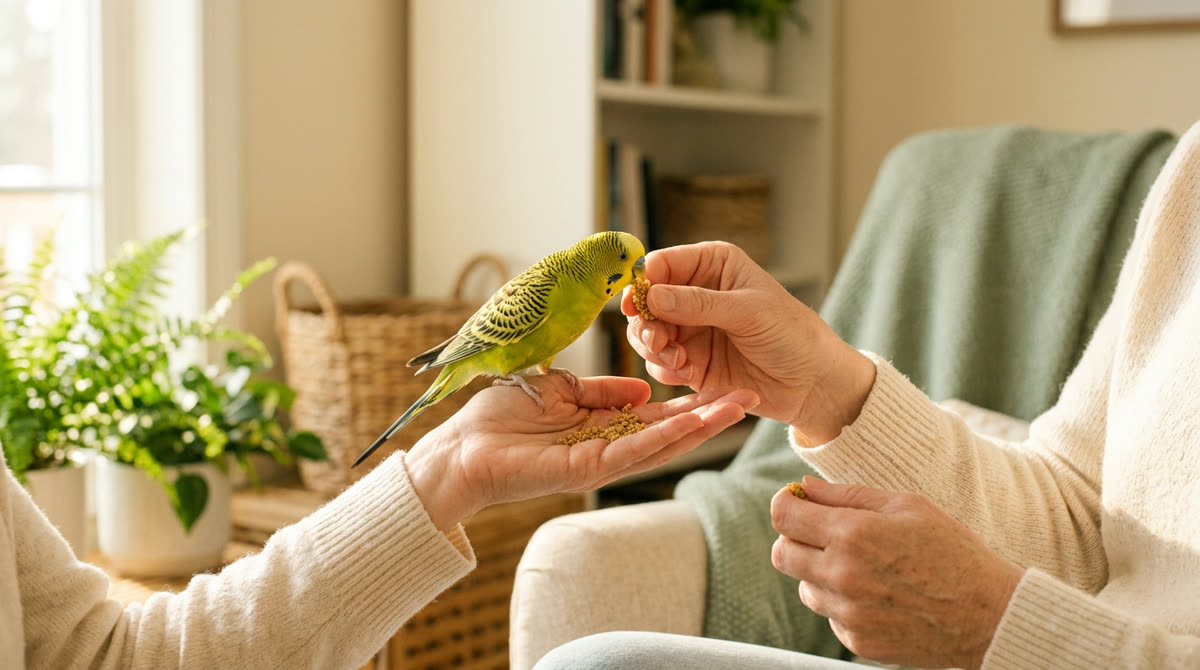
A calm, safety-first approachThis guide provides general education. Contact your veterinarian when symptoms are painful, persistent, or unusual.
- 1
Prepare a safe, reassuring home
Taming a budgie starts with making its new home feel safe, because a frightened bird is focused on escape rather than learning who you are. For one budgie, choose a rectangular cage at least 30 inches wide, 18 inches deep, and 18 inches high, preferably larger, with bar spacing no wider than 1/2 inch and enough unobstructed space to move between perches. Place it against a wall in a room where people spend calm, predictable time, with at least one comfortable perch near your eye level while you are seated. Keep the cage away from kitchens, drafts, direct midday sun, aerosol sprays, scented products, and fumes from overheated nonstick cookware, which can be deadly to birds. Set out two or three appropriately sized natural-wood perches of different diameters, accessible food and water dishes, and a few toys without crowding the flight space. Initially offer the food your budgie already recognizes, and arrange a new-bird examination with an avian veterinarian rather than combining relocation with an abrupt diet change. If you already have birds, keep the newcomer in a separate room with separate equipment and ask your veterinarian about quarantine, commonly at least 30–45 days, before introductions.
- Wide cage with bar spacing of 1/2 inch or less
- Familiar food and fresh water within easy reach
- Natural-wood perches and uncluttered movement space
- Quiet location away from cooking fumes and predators
- Avian veterinarian’s contact details saved
Good to know: Do not clip a budgie’s wings to make it dependent on you. Preventing escape does not build trust, and clipping can increase fear and the risk of falls.
- 2
Let your budgie settle into a routine
For the first 48–72 hours, prioritize quiet observation and essential care rather than asking your new budgie to step onto your hand; very nervous birds may need longer. Approach from the front or side at a relaxed pace, say the same gentle greeting, and move food bowls slowly so your arrival becomes predictable. Spend 5–10 minutes sitting approximately 3–6 feet from the cage, two or three times daily, reading aloud or speaking softly without staring directly at the bird. If it presses against the far bars, leans away, or stops eating whenever you approach, increase the distance until it can resume normal activity. Keep meal checks, cleaning, and bedtime reasonably consistent, and provide approximately 10–12 hours of quiet, dark sleep each night without covering the cage in a way that restricts ventilation. Look for relaxed eating, preening, stretching, or exploration in your presence, since these are better signs of readiness than simply remaining motionless. A budgie that sits frozen may be frightened rather than tame, so do not interpret its stillness as permission to touch or pick it up.
Good to know: Give the cage a quiet side where your budgie can retreat without being watched closely. Choice and a predictable routine help it feel secure faster than constant attention.
- 3
Learn its signals and find a reward
Before bringing your hand close, learn your budgie’s individual signs of comfort and concern so you can adjust the session before fear escalates. A comfortable bird may hold its feathers loosely, balance normally, preen, and return to eating, while leaning away, flattening its feathers, opening its beak toward you, or repeatedly seeking an escape route means you should pause. Read several signals together and consider the situation, because chirping, fluffing, or quietness alone does not reliably tell you how a bird feels. Identify a favorite food by observing what it chooses from its familiar diet, with spray millet often providing a convenient reward that can be offered at a distance. Use a spray long enough to keep your fingers comfortably away from the bird, but allow only one or two small bites per reward rather than letting every session become an extended millet meal. Keep its normal food available throughout training, and never delay meals or remove food to make the budgie hungry enough to approach. Begin with sessions lasting just 2–3 minutes, once or twice daily, and end while your bird is still calm instead of continuing until it refuses or retreats.
- Watch for leaning away or escape attempts
- Identify a familiar, high-value food
- Reward with one or two small bites
- Keep normal meals available
- Finish before attention or confidence fades
Good to know: Some budgies make progress within days, while others need weeks or months. Age, previous handling, temperament, and health all affect the timeline; none makes force a useful shortcut.
- 4
Offer treats through the cage bars
Start hands-on trust building from outside the cage, where the bars create a reassuring boundary and your budgie can choose whether to approach. Hold a millet spray steadily near a perch through the bars, keeping your fingertips outside and avoiding pushing the spray toward the bird’s face. If your hand alone causes concern, first practice resting it several inches from the cage for 10–20 seconds, then withdrawing while the bird remains comfortable. When the budgie looks toward the treat, leans closer, or takes a step toward it, calmly acknowledge the movement and keep the food accessible rather than moving it farther away. Once it takes a bite, use a soft, consistent marker such as “good” at that moment so the word gradually predicts a reward. If it does not approach within about 30–60 seconds, withdraw without fuss and make the next attempt easier by increasing your distance or choosing a quieter time. Repeat short sessions until the bird approaches readily across several attempts over at least two sessions, rather than progressing after one unusually brave bite.
Good to know: Avoid wiggling the millet, tapping the bars, or following the bird around the cage. A steady offer teaches that your hand predicts something pleasant without pursuing it.
- 5
Introduce your hand inside the cage
When your budgie reliably accepts treats through the bars, close the room’s doors and windows, turn off fans, and keep other pets out before opening the cage door. Sit beside the opening and initially hold the treat at the threshold, allowing the bird to investigate without having your whole hand enter its space. Over multiple successful repetitions, move your hand only 1–2 inches farther inside, staying below its head and away from its preferred retreat perch. Rest your forearm against a stable surface if possible, because trembling fingers and sudden adjustments can make an otherwise gentle approach feel unpredictable. Keep the first hand-inside attempts to approximately 30–60 seconds within a short session, rewarding voluntary approaches and withdrawing slowly before the bird becomes uneasy. If it climbs away, lunges, or begins frantic flapping, stop advancing, give it space, and return to the previous successful distance at the next session. Do not corner, stroke, or grab it at this stage, because accepting food near a hand is not the same as consenting to touch.
- Secure the room before opening the door
- Begin with the treat at the doorway
- Advance only 1–2 inches at a time
- Keep the retreat route clear
- Retreat a stage when fear appears
Good to know: Change only one difficulty at a time: hand distance, duration, or movement. Keeping the other elements familiar makes it easier to identify what your budgie finds worrying.
- 6
Teach a voluntary step-up
Begin step-up training when your budgie comfortably eats beside your still hand, using either a steady index finger or a short, bird-safe handheld perch if fingers remain intimidating. Offer the stepping surface just in front of its feet at roughly the same height as its current perch, without pressing against its chest or nudging its toes. Position the millet so the bird can reach it by shifting forward comfortably, and reward successive small efforts such as looking at the perch, touching it, or placing one foot on it. Once it begins transferring both feet reliably, say “step up” once just before that movement and mark the completed step with your quiet “good” followed immediately by a bite. Hold still for 1–2 seconds initially, then offer the original perch again so the bird learns that stepping onto you does not mean losing control of where it goes. Practice only three to five repetitions per session, gradually building toward 5–10 seconds of comfortable standing before introducing a tiny hand movement. If your budgie steps off immediately or uses its beak to test the surface, remain steady rather than jerking away, and make the next repetition easier if it seems uncertain.
- Offer a finger or stable handheld perch
- Reward one-foot attempts before expecting both feet
- Say the cue once, without repeated prompting
- Teach stepping off as well as stepping on
- Add movement only after standing feels easy
Good to know: A beak may function as an extra point of support during climbing, so exploratory contact is not automatically a bite. Do not flick the beak, blow in the bird’s face, or punish hesitation.
- 7
Practice in a bird-safe room
Plan the first out-of-cage session in one secured room after your budgie has settled, knows where its food is, and preferably steps onto a finger or handheld perch, while recognizing that exercise should not be postponed indefinitely until perfect tameness. Cover windows and large mirrors visibly, close toilet lids, remove open water containers, put away toxic plants, block dangerous gaps, and turn off all ceiling and portable fans. Keep cats, dogs, and other animals outside the closed room, even if they usually seem calm around the cage. Schedule at least 30–60 minutes of unhurried supervision, place a stable landing perch near the cage door, and let the bird exit voluntarily instead of tipping or pulling it out. During its first flights, remain seated or move slowly, allow it to orient itself, and offer the familiar step-up only when it has landed securely. Encourage return with the familiar cue, a millet reward just inside the doorway, and its usual food available in the cage, rather than chasing it or withholding meals beforehand. If it will not return immediately, reduce activity in the room and wait while supervising, since a rushed capture can undo the trust you have built.
- Doors and windows closed
- Fans off and reflective hazards covered
- Other animals kept outside
- Water, plants, and entrapment hazards removed
- Landing perch and return reward ready
Good to know: Never leave a loose budgie unattended, and do not switch off all the lights to catch it. If an urgent situation requires capture, prioritize safety and seek an avian professional’s guidance on safe handling; never compress a bird’s chest.
- 8
Troubleshoot fear, biting, and setbacks
If progress stalls, review what happened just before the difficulty: a faster approach, a different person, a noisy appliance, inadequate sleep, or a session that lasted too long may have raised the challenge. Return to the last easy exercise for the next few sessions, shorten practice to 1–2 minutes, and reward calm participation rather than repeatedly testing the difficult behavior. When a budgie bites, avoid yelling, shaking your hand, or forcing another step-up; lower it toward a safe perch if necessary, allow it to step off, and reassess the approach. A bird that accepts millet but avoids fingers may benefit from a handheld perch, while one that guards its cage may be more comfortable practicing voluntarily at the doorway or on an outside stand. If you have two budgies, offer each separate turns and reward individual approaches without isolating bonded birds simply to make them dependent on you. Stop training and contact an avian veterinarian promptly if a previously active bird becomes persistently fluffed, unusually sleepy, less interested in food, or shows changes in droppings, balance, or normal behavior. Open-mouth breathing at rest, pronounced tail bobbing with breathing, collapse, significant bleeding, or inability to perch warrants urgent veterinary attention rather than being treated as a taming problem.
- Identify what changed before the setback
- Shorten sessions and lower the difficulty
- Use a perch if hands remain frightening
- Never punish a bite or force contact
- Treat sudden behavior changes as a possible health concern
Good to know: Budgies can hide signs of illness, so a bird that seems unusually “easy to handle” because it is weak or inactive needs veterinary assessment. Do not continue training to see whether a treat perks it up.
- 9
Maintain trust with daily choices
Once your budgie steps up willingly, maintain the skill with one or two 3–5-minute sessions daily, alongside supervised exercise, foraging, and relaxed company that does not always involve demands. Practice useful variations gradually, such as moving your hand a few inches, stepping onto a travel-carrier perch, or approaching a familiar person in another part of the same room. Introduce new household members one at a time, asking each person to begin with stillness and treat offers rather than assuming your bird will transfer its trust immediately. Continue rewarding challenging or unfamiliar requests, and mix well-learned step-ups with other things your budgie values, such as access to a favorite play stand, without abruptly removing food rewards. If it solicits touch, offer brief scratches only around the head and neck, stopping when it moves away and avoiding stroking the back, belly, or beneath the wings. Keep a simple weekly record of training successes, appetite, droppings, and, once it can step onto a scale voluntarily, weight on a gram scale under consistent conditions, discussing a downward trend or unexpected change with your avian veterinarian. Successful budgie taming means a bird that approaches willingly, can decline interaction safely, and recovers confidence after small surprises—not one that tolerates restraint or accepts every request.
Good to know: Some trusting budgies never enjoy being petted, and that is normal. Voluntary approaches, relaxed companionship, and reliable cooperative handling are meaningful signs of a strong bond.

Ask about this guide
Leave a comment or a question about your own pet and the Pawlito assistant replies right away with practical next steps.